What is a zygomatic implant, and who is it for?
It isn't a screw that goes in through your face. It's an implant placed through the mouth that rises to the zygoma, the cheekbone, and anchors there by its tip. Hence the name.
If a dentist has told you it's dangerous, that reputation has an origin and a date — and part of it still holds. I'll show you which part, and what makes it weigh less today.
What this page doesn't do: it gives no prices, promises no result and never shows the benefit without the risk, or the risk without what lowers it. My conflict of interest is declared at the end.
What is a zygomatic implant, and who is it indicated for?
A zygomatic implant, the kind Dr. Fernando Giovanella places in Blumenau, Brazil, starts in the maxilla, the upper jaw, and ends anchored in the cheekbone, the zygoma — which is why it's long: about 3 to 5 centimeters, where a conventional implant is 0.5 to 2 centimeters1,2. It's indicated when the upper jaw no longer has the bone to hold conventional implants and no smaller option will do.
In 1 minute
- Where it anchors: by its tip, in the cheekbone; in the mouth, a rigid bridge joins it to other implants3.
- Who is a candidate: someone with an atrophied upper jaw, too little bone for conventional implants and no smaller option that works3.
- Who should not have one: anyone with a contraindication2 or with a smaller option that works, such as a graft or tilted implants (All-on-4).
- What the studies show: according to the 2026 Cochrane review, compared with a bone graft, it probably loses fewer implants and gets you to fixed teeth sooner1.
- Complications: the same review says it probably brings more complications1; the most reported is sinusitis, which in the reviews showed up less with the implant outside the sinus8.
- How to start: with a reading of your CBCT scan, the kind of CT scan the consensus recommends before a zygomatic implant2,3.
Does a zygomatic implant go in your face? Where exactly does it anchor?
A zygomatic implant sits under the skin and is placed through the mouth: its head stays inside the mouth, and its body rises until the tip anchors in the zygoma.
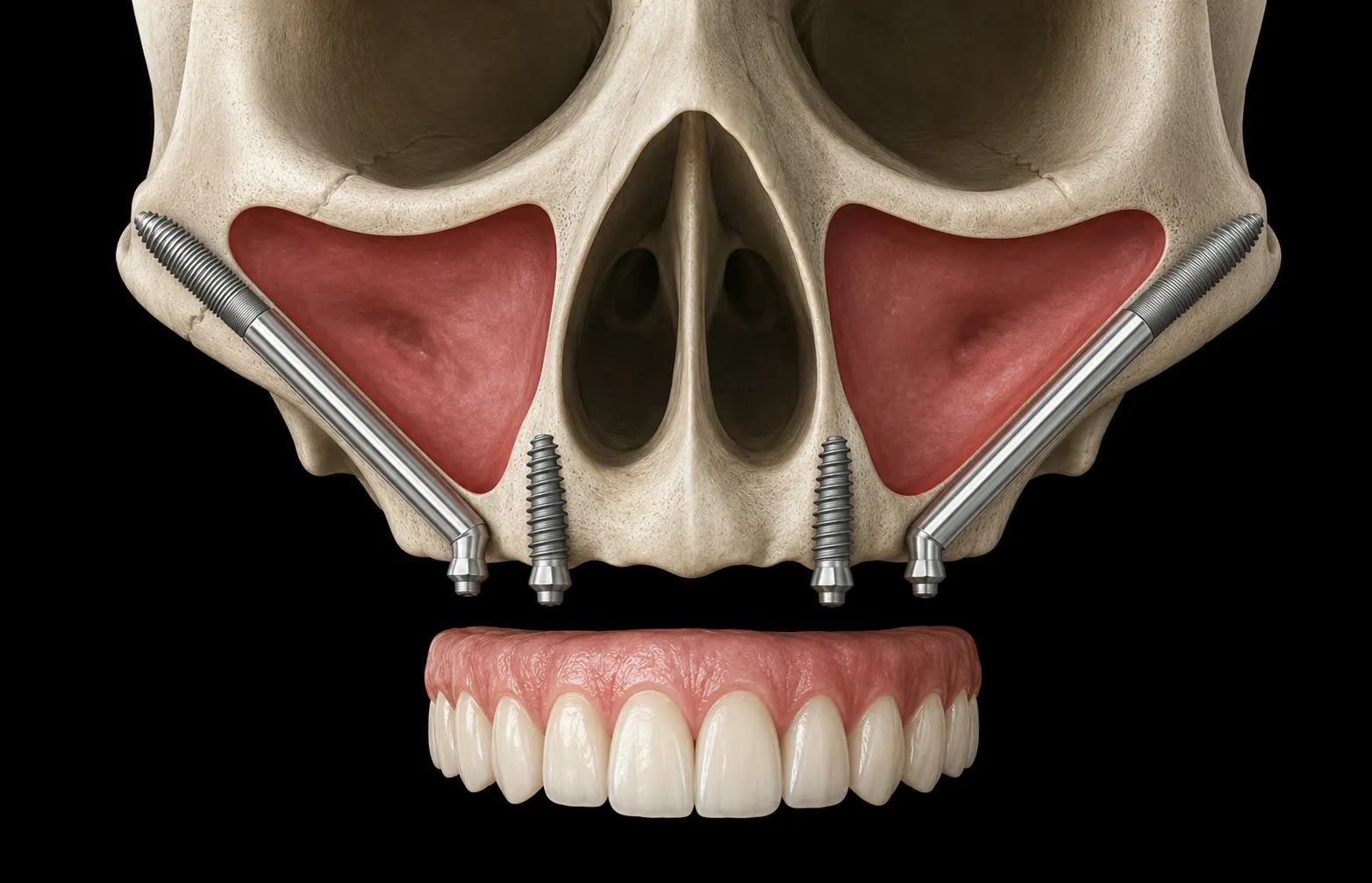
On the way, it passes the maxillary sinus, the air space above your back teeth: through it, hugging its wall, or outside it. It sounds like an engineer's detail, but it changes the risk of sinusitis a great deal.
Why that bone? Because the zygoma usually has enough density to hold the tip of the implant1,2 and, as a rule, it's still there when the bone in the mouth is gone (why the bone goes).
Usually there's one on each side, with conventional implants in front, all joined by a rigid bridge; when even the front has no bone, it's four zygomatic implants. Joined like this is how the studies report high survival3.
For one missing tooth, it isn't the answer; and in the lower jaw it has nothing to anchor in, as the questions on the page about missing bone explain.
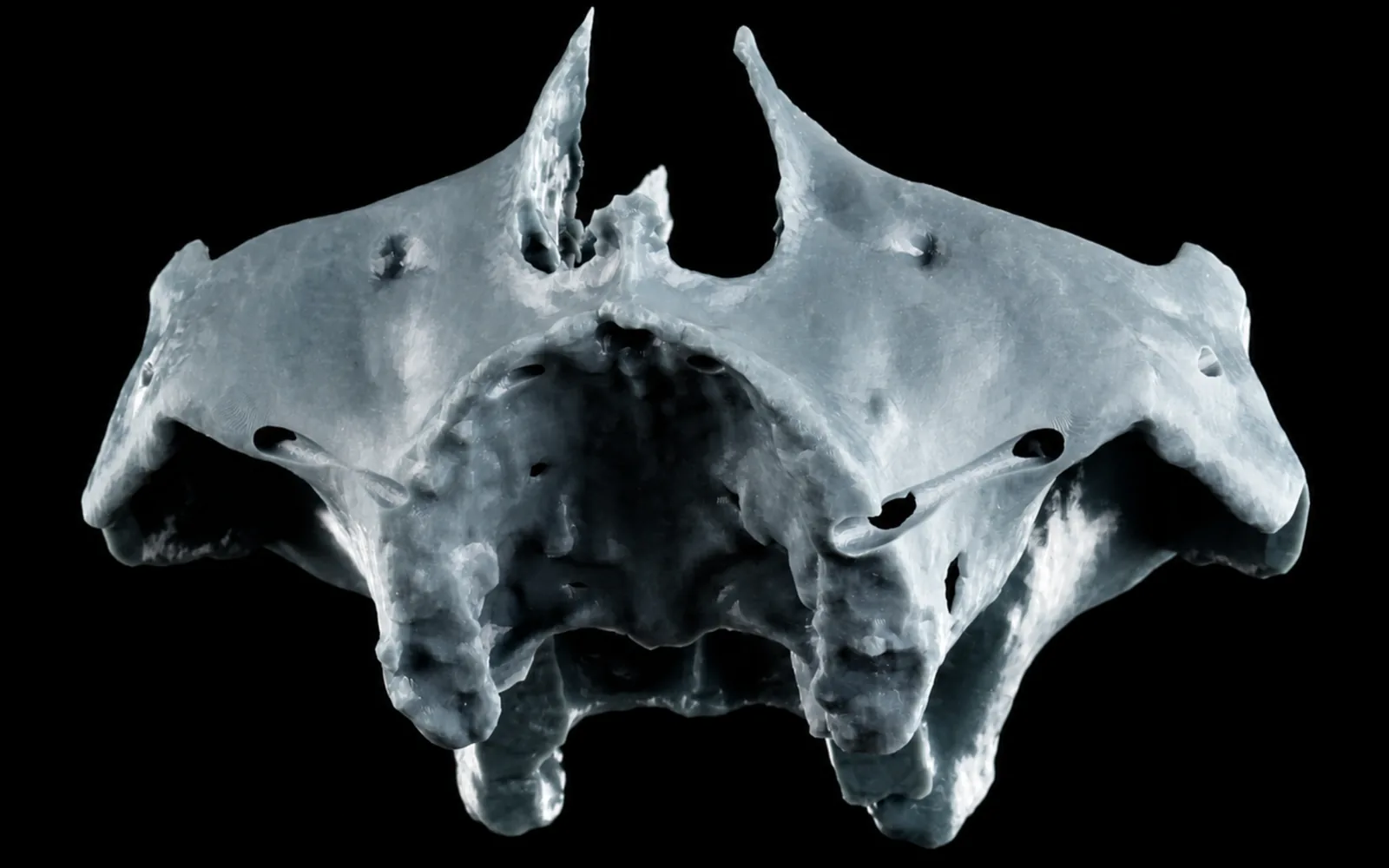
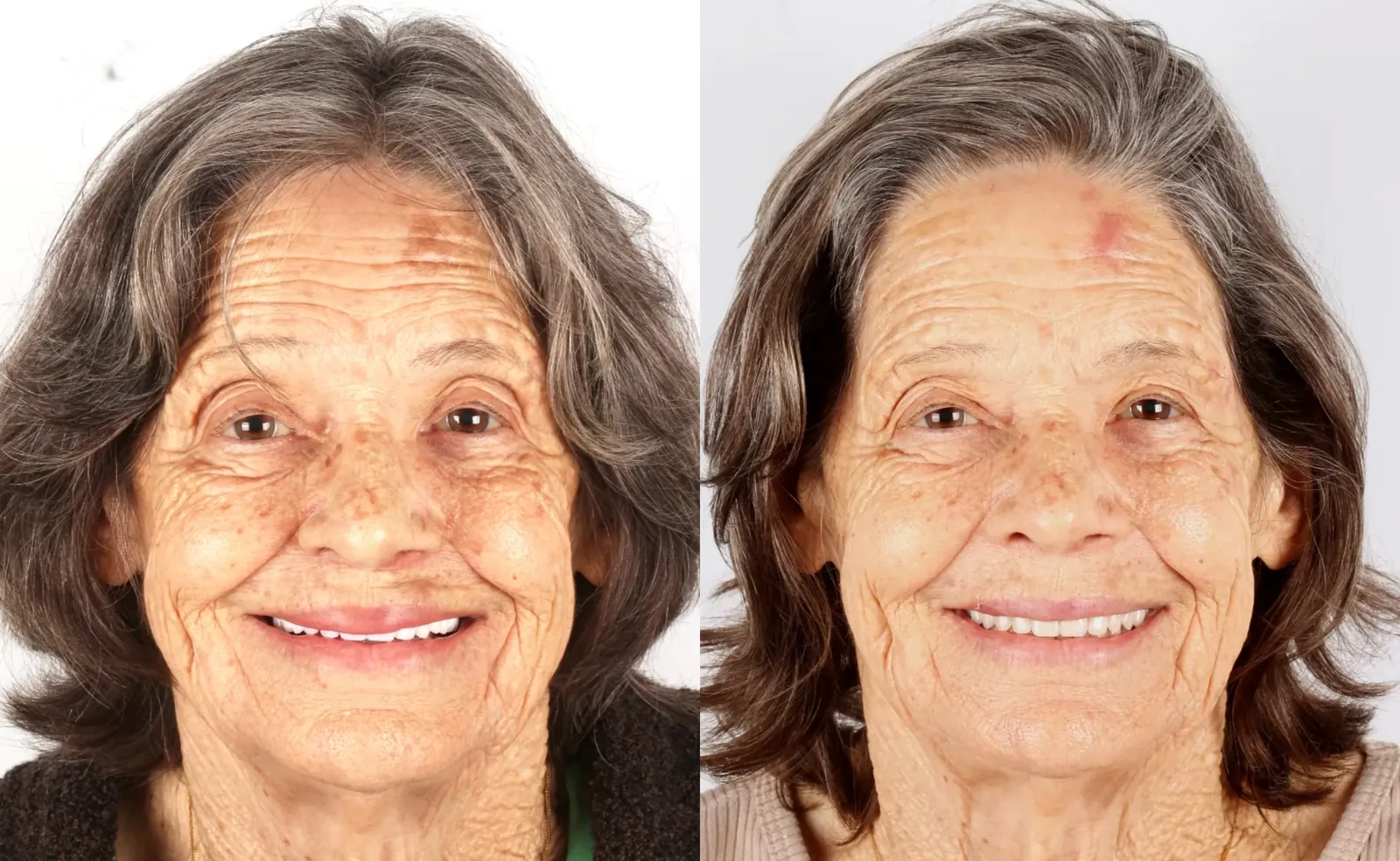
Knowing where it sits, though, still doesn't tell you whether it's for you.
Who can have a zygomatic implant? Am I a candidate?
You're a candidate when the bone loss in your upper jaw is too great for conventional implants and the smaller options won't work either.
The indication is narrower than the internet makes it look.
The 2023 international consensus of the ITI, an association of implant professionals, lists the indications: atrophy or missing bone in the upper jaw; earlier grafts or implants that didn't work; the choice to avoid grafts done in stages; and part of the upper jaw lost to the removal of a tumor, to trauma or to a birth defect3.
One of the 2023 reviews behind that consensus adds a caveat: in severe atrophy, avoiding extensive staged grafts and getting fixed teeth soon are possible advantages of a zygomatic implant, not reasons enough to choose one — and many studies treat the one as if it were the other2.
I agree. Wanting it fast is a fair wish. It isn't an indication.
If you had a graft that didn't take, there's a section just for that on the page about missing bone.
So far, who can. Now, who shouldn't — and to me, that's the most important part.
Who should not have a zygomatic implant?
Two groups should not have a zygomatic implant: people with a contraindication, and people with a smaller option that works.
- low immunity
- pregnancy
- uncontrolled diabetes
- alcohol or drug dependence
- radiotherapy to the head and neck above 70 Gy (the unit of radiation dose)
- treatment with bisphosphonates — drugs used, among other things, against osteoporosis
- mouth opening under 3 cm
- acute sinusitis
- chronic sinusitis with a sinus that cannot drain
- any change in the cheekbone
- smoking
- conditions that can be controlled before surgery
A zygomatic implant is the last rung of a ladder, not a shortcut past the others: according to the literature, some of the people who would have needed one in the past can now be treated with less — a graft with bone substitutes, with or without short or narrower implants2.
The whole ladder and how to find out whether you really need the last rung are on the page about missing bone.
The literature lists as contraindications2 those of any surgery under anesthesia, two treatments — radiotherapy above 70 Gy to the head and neck, and bisphosphonates — and conditions of the mouth and face, such as a mouth that opens less than 3 cm. Smoking and illnesses that can be controlled before surgery are relative: they weigh against it, but don't close the door on their own2.
Don't rule yourself out over a single word on that list: it says uncontrolled diabetes, not diabetes.
The maxillary sinus gets an exam of its own, especially if you've had sinusitis before: if it doesn't drain well, it may need treating before surgery, even with no symptoms at all3,4.
Maybe none of this worries you as much as a sentence you once heard from a dentist. Let's get to it.
Why do many dentists still avoid, or criticize, zygomatic implants?
In my opinion, much of that distrust comes from what the technique was like at the start — and the start gave it reasons.
The zygomatic implant was born with Professor Per-Ingvar Brånemark in the late 1980s: it crossed the sinus, and the fixed teeth waited for a second surgery — in a 2003 series, 6 to 8 months later3,4,5,6.
To see the path, a window of about 1 cm by 0.5 cm was opened in the wall of the sinus; and the head of the implant often came out on the side of the palate, the roof of the mouth, with a bulkier bridge there which, according to one review, can get in the way of cleaning and speech4,7.
But that history doesn't say the old technique lost more zygomatic implants: in the reviews, survival is similar across techniques. What changed was the complications — pooling studies that differ a lot from each other, sinusitis in 9.5% of cases with the original technique and in 4.4% with the approaches that follow the anatomy3,4,5,8. The authors themselves note that part of that difference may come from the dates: the studies of the newer approaches are more recent, and materials have improved4.
The old technique held the implants. The price was paid in the sinus, the palate and the feeling of the face — and that price is what came down.
In a 2023 review that separated the two techniques, altered sensation in the face, tingling or numbness, was reported in 10.78% of cases with the original technique and in 0.55% with the approaches that follow the anatomy; direct surgical complications, in 6.91% against 1.60% of cases3,4,5,8. It's a descriptive comparison, of studies that differ a lot from each other, and it didn't reach zero; what remains is further down.
Nor is there a right technique and a wrong one: the path is set by each person's anatomy and by the bridge being planned4,5,9.
Today, in the approaches that follow the anatomy, the aim is to choose the path from where the tooth will be, and fixing the teeth right after surgery has become the most common choice: in a 2023 systematic review, it was the protocol for 89.6% of implants in the studies of today's approaches, against 22.3% in the studies of the original technique4,5.
The consensus recommends a CT scan before a zygomatic implant; one of the reviews behind it calls 3D analysis mandatory, with 2D imaging good only for screening2,3.
My opinion, again: hard as it is to believe, some still plan zygomatic implants on a panoramic X-ray alone. With the 3D planning that exists today, that's no longer acceptable.
So how is it done today, from the scan to the tooth? It starts far from the chair.
How is a zygomatic implant done, from the scan to fixed teeth?
In six stages, and surgery is only the fourth: a zygomatic implant starts on a CBCT scan and ends with the final bridge.
- 1CBCT scan
- 2Planning
- 3Guide
- 4Surgery
- 5Temporary teeth
- 6Final prosthesis
- The CBCT scan. A 3D exam of the upper jaw, the cheekbones and the sinuses. It can be one you already have, if it takes in the cheekbones.
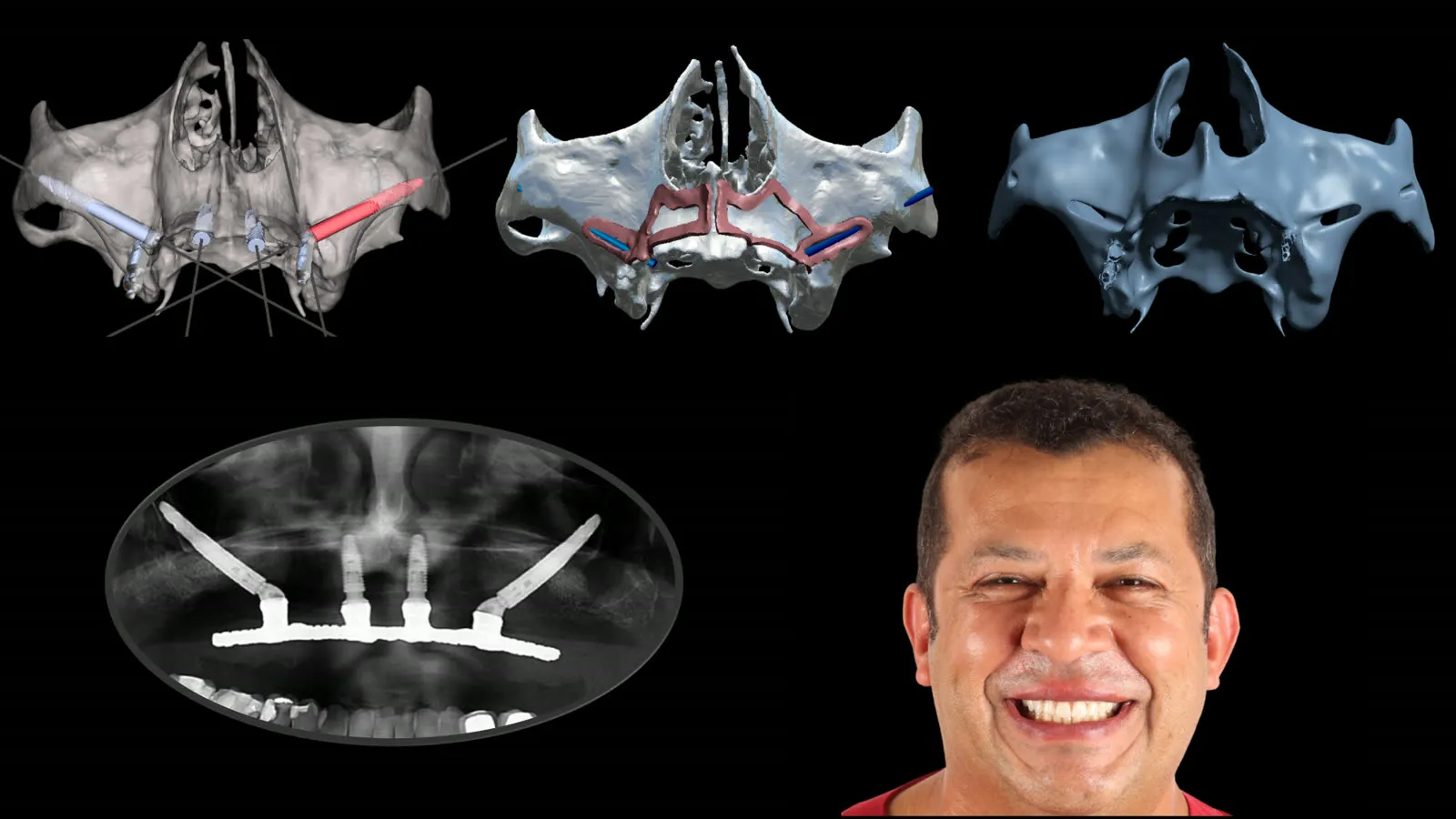
- The plan. I do it myself, with a virtual simulation and a prototype printed on the clinic's own 3D printer. On screen, each implant's path is drawn from the teeth you'll have to the cheekbone, deciding where it runs in relation to the sinus. Your surgery happens twice: the first one is virtual.
- The SkinGuide Zygoma® guide. It's the transfer guide: a thin piece of resin that carries each implant's planned position into the surgery, steering the preparation of the bone and the placement. The aim is for the implant to follow the outer wall of the sinus, according to each patient's anatomy, without opening a large window into the sinus. The guide marks the path; the bone stays in the surgeon's view. To me, it's that path, decided beforehand, that makes the surgery more predictable and safer — more, not completely: no surgery is.
- The surgery. Real surgery, not a minor procedure: it calls for sedation or general anesthesia, a wider opening of the gum to expose the bone, and work close to important structures in the middle of the face2,5. It takes two to four hours. Even for zygomatic implants, it's usually done under oral or intravenous sedation; at the clinic, intravenous sedation is given and monitored from start to finish by a physician anesthesiologist from Anesteclin10. General anesthesia is kept for surgery that runs past four hours, such as a retreatment where old implants have to come out; then it's done at the day-surgery unit of Hospital Unimed Blumenau, downtown11,12. The choice is made case by case, and either way you're expected to go home the same day.
- Provisional fixed teeth. If the implant is firm at surgery, the provisional bridge can be fixed soon after. It isn't always — a 2023 review asks that patients know beforehand that the plan may change on the day — and waiting is also accepted by the consensus2,3. The timing for your case comes out of the plan.
- The final bridge. In a 2023 review, in the studies where the teeth were fixed straight away, the provisional was replaced by the final bridge 3 to 6 months after surgery5. Before that, I check that the bone has bonded to each implant.
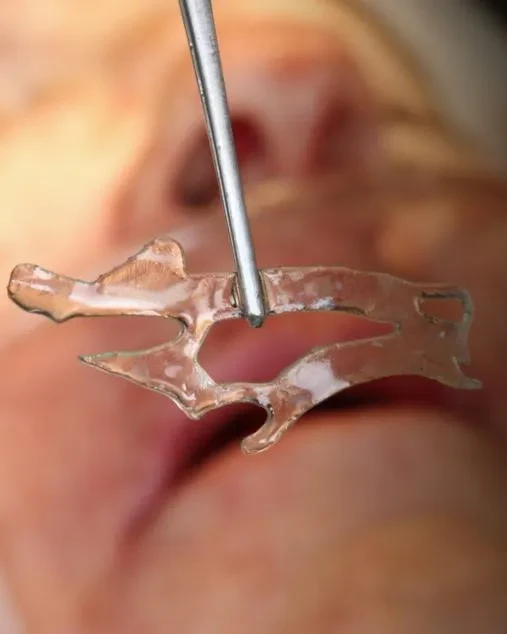 Step 3The SkinGuide Zygoma® guide: a thin piece of resin, designed on the computer and printed.
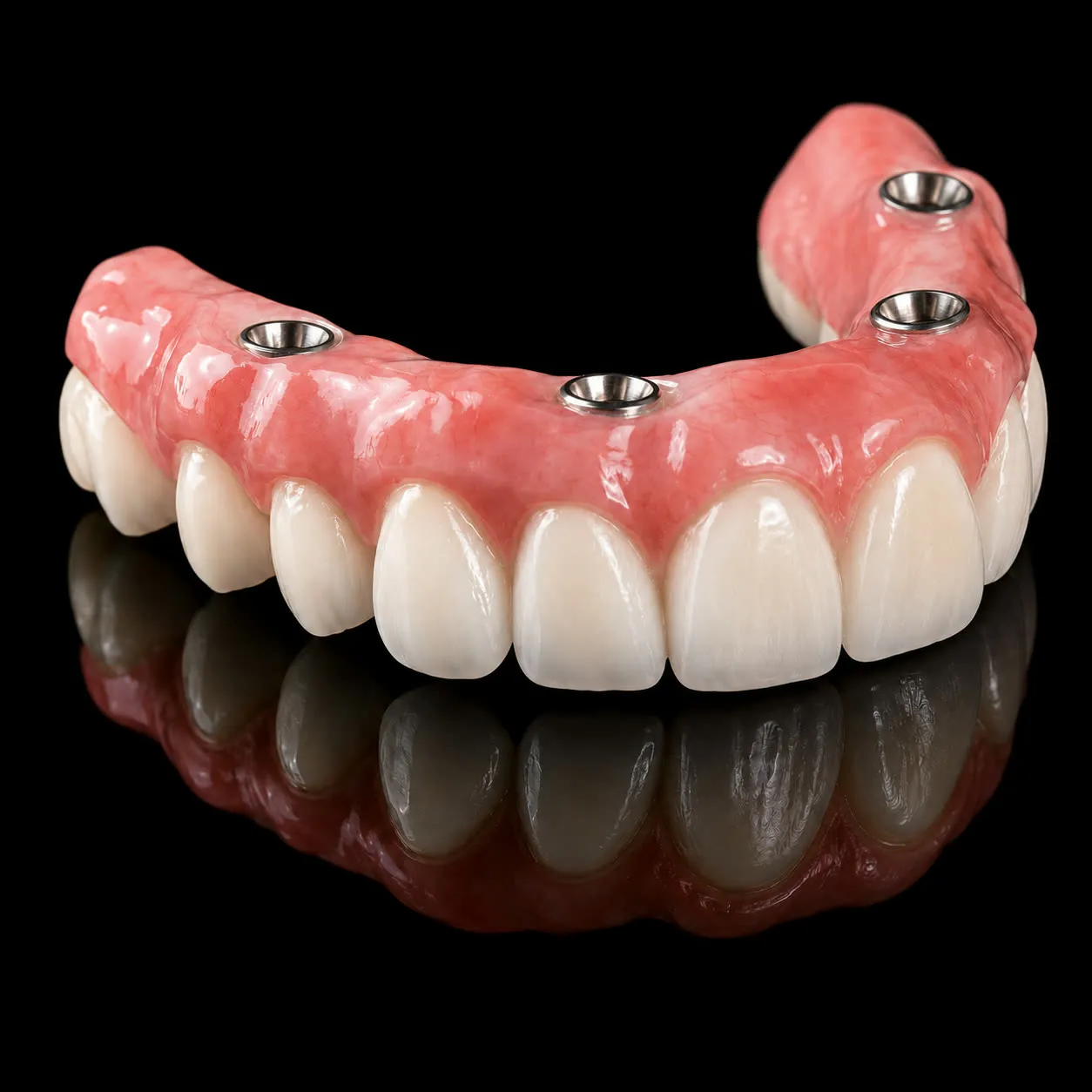 Steps 5 and 6Fixed teeth for the whole arch, screwed onto the implants.
Whether a zygomatic implant is worth it in your case is your call — and it starts with the numbers, including the ones on the other side.
Do zygomatic implants last? And what do the studies say about the risks?
They last, in the great majority of cases, and the other side shows up mostly in the sinus. None of the numbers below are mine or this clinic's: they come from studies by many surgeons, from thousands of patients down to a few dozen.
And look at the dates. In a 2023 long-term meta-analysis, the studies that report the year of surgery followed patients operated on up to 2012; in many of them, the implant ran through the sinus5. The same meta-analysis records that, in survival and in fixing the teeth straight away, treatment has evolved5. In a 2022 review, more recent studies reported less sinusitis and fewer openings between the mouth and the sinus than older ones8.
But sinusitis can appear many years later, with any technique, and it's reported more the longer the follow-up5,13,45. The longest follow-up of an approach that follows the anatomy, with four zygomatic implants per patient and funded by an implant manufacturer, reported sinusitis in 12.5% of cases, on average ten years later5,13,45.
Even so, my reading is that much of the longest-term data describes implants placed with less control than we have today. So I expect the long-term complications of zygomatic implants done now to be lower — that's my opinion, because long studies comparing today's technique with the old one are still lacking5.
For. Over twelve years, a 2016 review of 68 studies calculated that 95.21% of zygomatic implants were still in place13; at six years, a 2023 meta-analysis reached 96.2% survival5. Another, using only studies of five years or more, found them level with conventional implants: 96.5% against 95.8%, with no significant difference14.
Against a bone graft (the two, side by side), the 2026 Cochrane review, resting on a single randomized trial, also leans toward the zygomatic implant, with moderate certainty: at three years, out of every 100 people, probably about 22 fewer had an implant fail1,23.
In that trial, people who received zygomatic implants had a bridge in use, on average, 1.3 days after surgery; those who had a graft waited, on average, 444 days1,2.
Against. The same review, with the same certainty, found the other side: zygomatic implants probably bring more complications1 — about four in five people with them had at least one within three years, against about half with a graft1,23.
In the 4-month report of that same trial, with 71 patients, the authors wrote that the zygomatic group's complications, though more numerous, resolved on their own or could be handled1,23. The same review also points, with lower certainty, to fewer problems with the replacement teeth: about 12 fewer out of every 100 people1,23.
Sinusitis is the most reported complication — between about 2% and 14% of cases, in the reviews' averages — and it depends heavily on technique5,13,15.
Technique matters. In a 2024 meta-analysis of 9 zygomatic implant studies, sinusitis was reported in 4.36% of cases with the implant inside the sinus and in 0.00% with it outside — an estimate: by the statistical margin, the real figure may reach 1.22% of cases15. But zero isn't the rule, and a 2026 study found no difference in complications between inside and outside42,43,44.
These numbers belong to the techniques studied, not to SkinGuide Zygoma®, and people with no implants at all get sinusitis too. Still, I plan with those numbers in hand: the implant outside the sinus, whenever the anatomy allows.
- Implant inside the sinus4.36%
- Implant outside the sinus0.00%may reach 1.22%
But "survival" is a narrow word.
What are the complications of zygomatic implants, and what should I really expect?
Things can go wrong in the sinus, in the gum, in the feeling of the face and in the bridge — and that list is where I start the conversation, before any surgery date, along with what lowers each one.
"Survival" only counts presence: it leaves out the sinusitis that was treated, the screw that was retightened, the bridge that was remade.
In the bridge, what it leaves out is the usual repair work: the problems are the same as with bridges on conventional implants, and a fracture of the zygomatic implant itself is rare3. But the consensus warns that zygomatic implants may need more professional maintenance and have limits on chewing load3. In the gum, the same consensus calls hygiene at home essential3. And altered sensation in the face was reported far less with today's approaches, as you saw in then and now.
When a zygomatic implant fails, it tends to fail early: the reviews report about 2% lost in the first year, most of them within the first 6 months, and about 0.5% a year after that3,13. The average hides a range: among the studies in a 2023 meta-analysis, the one with the lowest result had 76.1% of zygomatic implants still in place at almost 12 years, and three studies lost no implants at all over 5 to 8 years5. Look at the dates again: these numbers, the good ones and the bad one, come from surgery done in another era5.
Sinusitis can appear years later. When it does, the studies report treatment with antibiotics, with surgery to get the sinus draining again, or with both, with no further consequences; only if that doesn't resolve it can the implant be lost3,13.
And the other side: the reviews report that most patients gain a great deal in quality of life and are highly satisfied, above all with chewing and with how they look3,17 — though, between a zygomatic implant and a graft, it isn't yet known which leaves people more satisfied1,23.
And sinusitis isn't a matter of luck: there are surgical maneuvers to reduce it, and they're the next question.
Do zygomatic implants cause sinusitis?
They can: sinusitis is the most reported complication of zygomatic implants, and it depends heavily on the technique5,13,15. But a shadow on the scan, such as mucosal thickening, isn't the same thing as sinusitis24,25.
In a study of 41 patients, the shadow in the sinus showed up in 12% before the zygomatic implant and in 46% after it; the complaint, measured by questionnaire, in 12% and 15%, with no statistical difference26. The authors' conclusion: zygomatic implants don't seem to be linked to serious sinus complications26.
That doesn't make the shadow something to ignore: the authors ask for the sinus to be followed, at the visit and on imaging3,26,27,28.
So where does sinusitis come from? Titanium inside the sinus, on its own, hasn't been shown to cause it4,5,29,30,31.
The reviews point to two doors. One is the seal around the implant, in the mouth: if it fails, it can open a passage into the sinus4,5,32,33. The other is the sinus's drainage into the nose, when it narrows3,4,28,31.
And that risk can be cut a long way, because technique is what weighs most. With the implant outside the sinus, a 2024 meta-analysis reported 0.00% sinusitis — up to 1.22% by the statistical margin15.
Some studies with the implant outside the sinus recorded no sinusitis at all. One, retrospective, followed 92 patients for almost three years on average38,39,40,41. Three others come from a single group in Bauru, Brazil: the largest, retrospective, gathered 75 patients operated on from 2003 to 2006, with 150 zygomatic implants, and its abstract doesn't say how long they were followed38; another, prospective, assessed 21 patients over 8 years, with no sign of sinus trouble38,39,40,41. Since it's the same team, I count the three as one.
But zero isn't the rule: in other studies with today's techniques, sinusitis showed up in about 10% to 13% of cases42,43,44. And a 2026 study, with 69 patients of the same surgeon, found no difference in complications between the implant inside and outside the sinus42,43,44.
When the anatomy forces the implant through the sinus, there's a maneuver to protect it: detaching and lifting the membrane that lines the inside of the sinus, and passing the implant beneath it. In a prospective study published in 2010, James Chow's team, in Hong Kong, did exactly that in 16 patients, with 37 implants: on CT, 6 to 24 months later, no implant had failed and there wasn't a single case of sinusitis16.
That's how I plan: outside the sinus whenever the anatomy allows; when it doesn't, with the membrane lifted and the implant passing beneath it. Sixteen patients and one team, in that study: a principle to plan by, not a promise.
The 2023 international consensus gives the order of treatment, as expert opinion: antibiotics first, which usually resolve it; if they don't, look into that drainage3,5. Removing the implant is kept for when none of that works: in a 2005 series, with patients operated on from 1998 to 2002, 3 of 31 zygomatic implants were removed for recurrent sinusitis3,5,37. The consensus sums it up this way: sinusitis is the most reported complication and the most common one that may lead to losing the implant, but there's no clear relationship between sinusitis and the survival of zygomatic implants3,13.
But not all sinusitis is bacterial: it can be viral or fungal24,34,35. That's why a consensus of ear, nose and throat specialists and dentists recommends that they and you decide together35,36.
If so much depends on technique, one question is left: in whose hands?
Who should perform zygomatic implant surgery, and how do I check the surgeon?
According to the literature, the surgery belongs with someone experienced in midface surgery and in implants2,3; in Blumenau, Brazil, the surgeon is Dr. Fernando Giovanella — the same person who reads your scan and draws the path of each implant.
 Dr. Fernando GiovanellaCRO-SC 8237The name and the number to look up in the public registers of the CRO-SC and the CFO.19,20
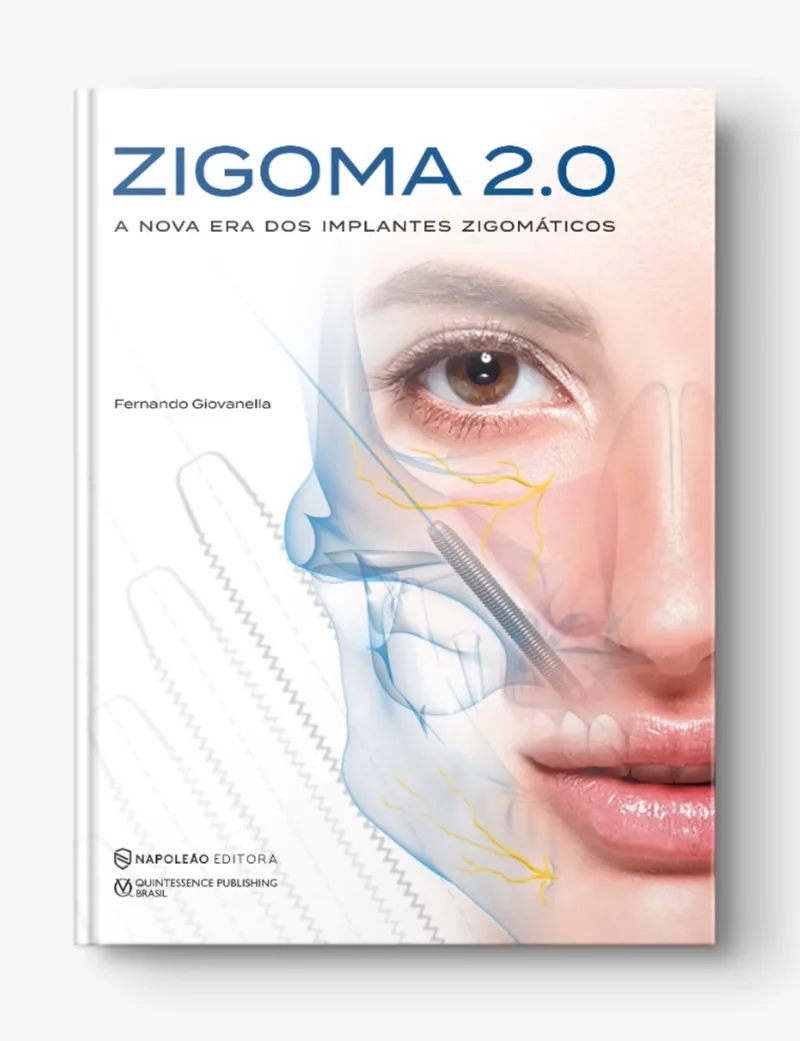 The bookZIGOMA 2.0 — A nova era dos implantes zigomáticos232 pages on the technique, written for surgeons, in Portuguese · Napoleão Quintessence, 202321
The consensus says success depends heavily on the skill and experience of whoever treats you, in the surgery and in the bridge; one of the reviews behind it records more complications where experience is limited2,3.
You don't have to take my word for it. Check. In Brazil, a dentist may only advertise a specialty registered with the dental council, and advertising one they don't hold is an ethics violation18.
The public registries of the CRO-SC and the CFO, Brazil's regional and federal dental councils, show whether a dentist is registered: search the surgeon's name — mine too19,20.
The rest is published. I'm the author of ZIGOMA 2.0 — A nova era dos implantes zigomáticos (the new era of zygomatic implants), a 232-page book on the technique, in Portuguese, written for surgeons21.
And I'm the sole author of a 2025 clinical report in the Journal of Prosthetic Dentistry on fixed teeth for a full arch without a graft22 — a single case: it shows how I work, it doesn't promise your result.
Take these questions to any surgeon — me included: Where will the implant run in relation to the sinus? Is the plan made on a CBCT scan? Who gives the anesthesia, and where? If an implant fails, what happens?
- Where will the implant pass in relation to the sinus?
- Is the plan made on a CBCT scan?
- Who gives the anesthesia, and where?
- If an implant fails, what happens?
If you've read this far, the next step is short.
I want to know whether a zygomatic implant is for me. Where do I start?
With a WhatsApp message to the clinic in Blumenau, Brazil, and your CBCT scan: Dr. Fernando Giovanella reads it himself and sends you his reading in writing.

I only confirm that a zygomatic implant is for you after I've seen your scan — never because someone told you that you need one.
Your scan is read by the same surgeon who would operate, and that written reading is preliminary until I examine you in person. Nothing is decided before you understand the plan — and the plan may be a smaller option, not a zygomatic implant.
No scan yet? It's taken near home; what kind, and how to send it, is in how treatment works when you live abroad.
No commitment and no pressure: it starts with a message and ends with a clear plan for your case. The message includes your consent to how the clinic handles health data — read it first.
Questions that tend to come after all this
Does a zygomatic implant hurt?
During surgery, anesthesia takes care of that: in Dr. Fernando Giovanella's surgeries, there's local anesthesia with sedation, oral or intravenous — the intravenous kind given by a physician anesthesiologist — and general anesthesia, decided case by case, is usually kept for surgeries longer than four hours. Afterward, the studies don't give a pain score; they report swelling, sometimes with temporary numbness, and bruising4,8, and, in one randomized trial, an average of 7 days away from normal activities, about the same as after a bone graft23.
How much does a zygomatic implant cost, and why is there no price here?
There's no price here because it would be dishonest: the number only comes after Dr. Fernando Giovanella has read your scan — two zygomatic implants or four, with or without conventional implants in front, anesthesia at the clinic or in hospital. And here's what I tell everyone: too expensive, you pay on the way in; too cheap, you pay on the way out, in a repair.
How long does a zygomatic implant last?
In the longest studies, of up to twelve years, the great majority of zygomatic implants were still in place13. Losses cluster in the first 6 months and, after the first year, run at about 0.5% a year, according to the reviews3,13. Over the years, the bridge3 and the sinus need attention: sinusitis can appear years later; in the studies that reported treatment, it was treated with no further consequences, and when it doesn't work, the implant may be lost3,13.
After a zygomatic implant, how long until I have fixed teeth?
It depends on whether the implant comes out of surgery firm; with Dr. Fernando Giovanella, the timing comes from your plan, not from an average. In the studies where the teeth were fixed straight away, the provisional was replaced by the final bridge 3 to 6 months after surgery5; when that firmness isn't there, the wait can add 4 to 6 months1,2.
I smoke, or I have diabetes. Can I have a zygomatic implant?
It depends on how much you smoke and how your diabetes is doing, and that's decided at the assessment, with Dr. Fernando Giovanella. Smoking is a relative contraindication2, and a 2023 review recommends that heavy smokers not have zygomatic implants4. With diabetes, the contraindication is the uncontrolled kind; diabetes that can be brought under control before surgery weighs against it, but doesn't rule it out2. Sometimes the answer is: not yet.
Does a zygomatic implant leave a mark on the face?
A cut on the face, no: in the techniques described in this page's sources, the bone is reached from inside the mouth, through the gum — which is how Dr. Fernando Giovanella operates — and none of them describes a cut in the skin4,5. Some long-term studies, with implants from another era5, recorded infections that spread outside the mouth4,5. What usually shows on the outside is swelling and bruising — bruising is the most reported direct surgical complication4,8.
I still have some upper teeth. Can they come out and the zygomatic implant go in during the same surgery?
Yes, but the consensus warns that the risk may be higher when the zygomatic implant goes in together with the extractions, and Dr. Fernando Giovanella weighs that case by case. Infection, the quality of the bone and the gum, the surgeon's experience and your own preference all go into the decision3. Sometimes taking the teeth out first and letting the gum settle is the prudent choice; sometimes it isn't.
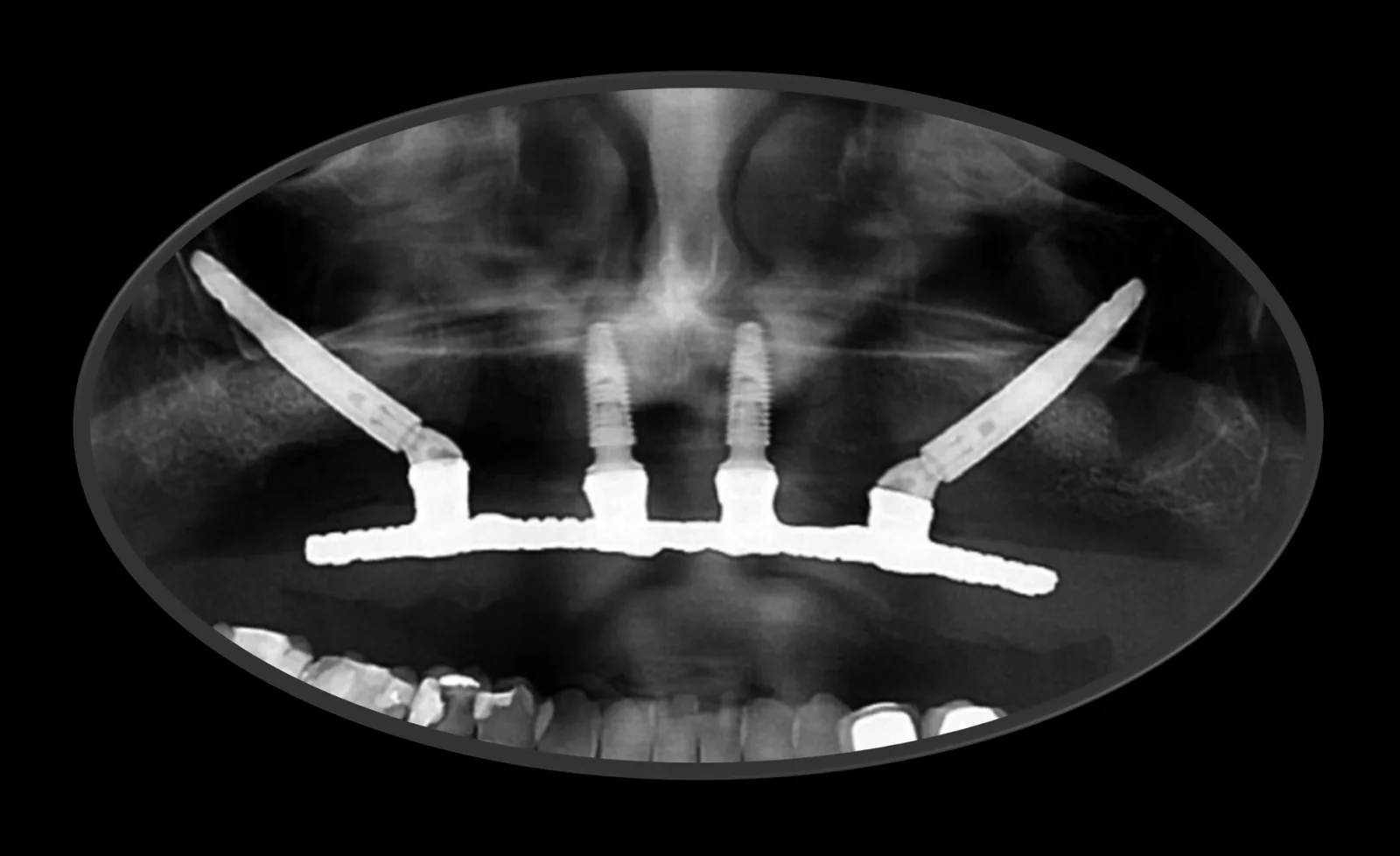
What does a zygomatic implant look like on an X-ray?
Like a long, slanted white line rising to the cheekbone: that's how it appears on the panoramic X-ray of a real case of Dr. Fernando Giovanella's, in Blumenau, Brazil, further up the page. Next to a conventional implant, it's much longer1,2. But an X-ray is a flattened image: it shows that the implant is there, not where it runs in relation to the sinus. That's the job of the CT scan the consensus asks for before a zygomatic implant2,3.
Read next
- Zygomatic implants or All-on-4: what's the difference?All-on-4 dental implants are a way of building a fixed arch — a full-arch bridge — on four implants; in the upper jaw, they sit in the jaw's own bone, with the two back ones tilted.
- What can I do if I don't have enough bone for dental implants?When there isn't enough bone for conventional implants, Dr. Fernando Giovanella, in Blumenau, Brazil, works through five options in a fixed order, from the smallest step to the largest: a bone graft (including a sinus lift); tilted implants that use the bone you still have in the front of the upper jaw; pterygoid implants that anchor behind it; zygomatic implants that anchor in the cheekbone; and, when even the front of the jaw is gone, four zygomatic implants.
- How does guided implant surgery work? Is it worth it?In guided surgery, as Dr. Fernando Giovanella does it in Blumenau, Brazil, the decision comes before the drill.
- If I get zygomatic implants abroad, what happens when I'm back home?After zygomatic implants with Dr. Fernando Giovanella in Blumenau, Brazil, you fly home with an implant passport and a letter for your dentist.
References
- Visconti RF, Greco K, Cotticelli C, Ambrosi A, Esposito MA. Interventions for replacing missing teeth: zygomatic implants for the rehabilitation of the severely atrophic edentulous maxilla. Cochrane Database Syst Rev. 2026;7(7):CD004151. doi:10.1002/14651858.CD004151.pub4 · PMID 42489150. https://pubmed.ncbi.nlm.nih.gov/42489150/ · plain language summary: https://pmc.ncbi.nlm.nih.gov/articles/PMC13393076/ — accessed 11 October 2026.
- Polido WD, Machado-Fernandez A, Lin WS, Aghaloo T. Indications for zygomatic implants: a systematic review. Int J Implant Dent. 2023;9(1):17. doi:10.1186/s40729-023-00480-4 · PMID 37391575. https://pubmed.ncbi.nlm.nih.gov/37391575/ — accessed 11 October 2026.
- Al-Nawas B, Aghaloo T, Aparicio C, Bedrossian E, Brecht L, Brennand-Roper M, et al. ITI consensus report on zygomatic implants: indications, evaluation of surgical techniques and long-term treatment outcomes. Int J Implant Dent. 2023;9(1):28. doi:10.1186/s40729-023-00489-9 · PMID 37698775. https://pubmed.ncbi.nlm.nih.gov/37698775/ — accessed 11 October 2026.
- Kämmerer PW, Fan S, Aparicio C, Bedrossian E, Davó R, Morton D, et al. Evaluation of surgical techniques in survival rate and complications of zygomatic implants for the rehabilitation of the atrophic edentulous maxilla: a systematic review. Int J Implant Dent. 2023;9(1):11. doi:10.1186/s40729-023-00478-y · PMID 37198345. https://pubmed.ncbi.nlm.nih.gov/37198345/ — accessed 11 October 2026.
- Brennand Roper M, Vissink A, Dudding T, Pollard A, Gareb B, Malevez C, et al. Long-term treatment outcomes with zygomatic implants: a systematic review and meta-analysis. Int J Implant Dent. 2023;9(1):21. doi:10.1186/s40729-023-00479-x · PMID 37405545. https://pubmed.ncbi.nlm.nih.gov/37405545/ — accessed 11 October 2026.
- Nakai H, Okazaki Y, Ueda M. Clinical application of zygomatic implants for rehabilitation of the severely resorbed maxilla: a clinical report. Int J Oral Maxillofac Implants. 2003;18(4):566–70. PMID 12939010. https://pubmed.ncbi.nlm.nih.gov/12939010/ — accessed 11 October 2026.
- Aparicio C, Ouazzani W, Aparicio A, Fortes V, Muela R, Pascual A, et al. Extrasinus zygomatic implants: three year experience from a new surgical approach for patients with pronounced buccal concavities in the edentulous maxilla. Clin Implant Dent Relat Res. 2010;12(1):55–61. doi:10.1111/j.1708-8208.2008.00130.x · PMID 19076181. https://pubmed.ncbi.nlm.nih.gov/19076181/ — accessed 11 October 2026.
- Tavelli C, Tedesco A. Survival and complication rate of zygomatic implants: a systematic review. J Oral Implantol. 2022, published 6 December 2022. doi:10.1563/aaid-joi-D-22-00008 · PMID 36473176. https://pubmed.ncbi.nlm.nih.gov/36473176/ — accessed 11 October 2026.
- Aparicio C. A proposed classification for zygomatic implant patient based on the zygoma anatomy guided approach (ZAGA): a cross-sectional survey. Eur J Oral Implantol. 2011;4(3):269–75. PMID 22043470. https://pubmed.ncbi.nlm.nih.gov/22043470/ — accessed 11 October 2026.
- Anesteclin Anestesiologia, Blumenau — official website, listing the team doctor by doctor, each with their Regional Medical Council (CRM) registration and specialist registration (RQE). https://anesteclin.com.br/ — accessed 7 October 2026.
- Unimed Blumenau. "Hospital Dia – Unidade Centro" (scheduled surgery; five operating rooms; post-anesthesia recovery room). https://www.unimed.coop.br/site/web/blumenau/hospital-unidade-centro — accessed 7 October 2026.
- Brazilian Ministry of Health — National Registry of Health Establishments (CNES), open data API: no. 6301223, Hospital Unimed Blumenau Unidade Centro (day hospital; Rua Ingo Hering, 20, Centro, Blumenau). https://apidadosabertos.saude.gov.br/cnes/estabelecimentos/6301223 — accessed 7 October 2026.
- Chrcanovic BR, Albrektsson T, Wennerberg A. Survival and complications of zygomatic implants: an updated systematic review. J Oral Maxillofac Surg. 2016;74(10):1949–64. doi:10.1016/j.joms.2016.06.166 · PMID 27422530. https://pubmed.ncbi.nlm.nih.gov/27422530/ — accessed 11 October 2026.
- Moraschini V, et al. Survival and complications of zygomatic implants compared to conventional implants reported in longitudinal studies with a follow-up period of at least 5 years: a systematic review and meta-analysis. Clin Implant Dent Relat Res. 2023;25(1):177–189. doi:10.1111/cid.13153 · PMID 36373779. https://doi.org/10.1111/cid.13153 — accessed 6 October 2026.
- Rocha RS, Vianna CP, Trojan LC, Padovan LEM, dos Santos MCGL. Comparison of sinusitis rate after sinus lift procedure and zygomatic implant surgery: a meta-analysis. Oral Maxillofac Surg. 2024;28(1):63–77. doi:10.1007/s10006-023-01159-1 · PMID 37266797. https://pubmed.ncbi.nlm.nih.gov/37266797/ — accessed 7 October 2026.
- Chow J, Wat P, Hui E, Lee P, Li W. A new method to eliminate the risk of maxillary sinusitis with zygomatic implants. Int J Oral Maxillofac Implants. 2010;25(6):1233–40. PMID 21197502. https://pubmed.ncbi.nlm.nih.gov/21197502/ — accessed 7 October 2026.
- Sáez-Alcaide LM, Cortés-Bretón-Brinkmann J, Sánchez-Labrador L, Pérez-González F, Forteza-López A, Molinero-Mourelle P, et al. Patient-reported outcomes in patients with severe maxillary bone atrophy restored with zygomatic implant-supported complete dental prostheses: a systematic review. Acta Odontol Scand. 2022;80(5):363–373. doi:10.1080/00016357.2021.2018494 · PMID 35044889. https://pubmed.ncbi.nlm.nih.gov/35044889/ — accessed 11 October 2026.
- Federal Council of Dentistry (CFO), Brazil. Code of Dental Ethics (Resolution CFO-118/2012), articles 43 and 44, as amended by Resolution CFO-271/2025. https://website.cfo.org.br/wp-content/uploads/2018/03/codigo_etica.pdf · https://sistemas.cfo.org.br/visualizar/atos/RESOLU%C3%87%C3%83O/SEC/2025/271 — accessed 8 October 2026.
- Santa Catarina Regional Dental Council (CRO-SC) — public registry search. https://cro-sc.implanta.net.br/servicosonline/Publico/ConsultaInscritos/ — accessed 6 October 2026.
- Federal Council of Dentistry (CFO), Brazil — public registry search. https://website.cfo.org.br/consulta-inscritos/ — accessed 6 October 2026.
- Zigoma 2.0: a nova era dos implantes zigomáticos (in Portuguese) — Napoleão Quintessence, 2023, 232 pages; e-book ISBN 9788548003240. Biblioteca Virtual (Pearson): https://www.bvirtual.com.br/NossoAcervo/Publicacao/222314 — accessed 6 October 2026.
- Giovanella F. Graftless complete arch rehabilitation using a facial approach for enhanced bone anchorage and prosthetic outcomes: a clinical report. J Prosthet Dent. 2025;134(2):295.e1–295.e6. doi:10.1016/j.prosdent.2025.03.046 · PMID 40221273. https://pubmed.ncbi.nlm.nih.gov/40221273/ · Accepted manuscript, open access — accessed 6 October 2026.
- Davó R, Felice P, Pistilli R, Barausse C, Marti-Pages C, Ferrer-Fuertes A, et al. Immediately loaded zygomatic implants vs conventional dental implants in augmented atrophic maxillae: 1-year post-loading results from a multicentre randomised controlled trial. Eur J Oral Implantol. 2018;11(2):145–161. PMID 29806663. https://pubmed.ncbi.nlm.nih.gov/29806663/ — accessed 11 October 2026. According to the authors, in the 4-month report of the same trial (Esposito M, et al. Eur J Oral Implantol. 2018;11(1):11–28 · PMID 29557398 · https://pubmed.ncbi.nlm.nih.gov/29557398/), the study received initial support from the manufacturer of the implants used, withdrawn before any results were known.
- Rosenfeld RM, Piccirillo JF, Chandrasekhar SS, Brook I, Ashok Kumar K, Kramper M, et al. Clinical practice guideline (update): adult sinusitis. Otolaryngol Head Neck Surg. 2015;152(2 Suppl):S1–S39. doi:10.1177/0194599815572097 · PMID 25832968. https://pubmed.ncbi.nlm.nih.gov/25832968/ — accessed 20 October 2026.
- Amin N, Walker A, Alobid I, Anari S, Bast F, Bhalla RK, et al. Defining appropriateness criteria for endoscopic sinus surgery in the management of adult dental implant patients with incidental maxillary sinus findings on conebeam computed tomography. Clin Otolaryngol. 2020;45(6):862–869. doi:10.1111/coa.13609 · PMID 32691945. https://pubmed.ncbi.nlm.nih.gov/32691945/ — accessed 20 October 2026.
- D'Agostino A, Trevisiol L, Favero V, Pessina M, Procacci P, Nocini PF. Are zygomatic implants associated with maxillary sinusitis? J Oral Maxillofac Surg. 2016;74(8):1562–73. doi:10.1016/j.joms.2016.03.014 · PMID 27070844. https://pubmed.ncbi.nlm.nih.gov/27070844/ — accessed 20 October 2026.
- Zhao K, Lian M, Fan S, Huang W, Wang F, Wu Y. Long-term Schneiderian membrane thickness changes following zygomatic implant placement: a retrospective radiographic analysis using cone beam computed tomography. Clin Oral Implants Res. 2018;29(7):679–687. doi:10.1111/clr.13259 · PMID 29774595. https://pubmed.ncbi.nlm.nih.gov/29774595/ — accessed 20 October 2026.
- Jin S, Ma H, Ling X, Tao B, Wang F, Wu Y. Longitudinal reactions of maxillary sinus in patients treated with multiple zygomatic implants: a modified radiographic evaluation with clinical follow-up. Clin Implant Dent Relat Res. 2023;25(6):1091–1102. doi:10.1111/cid.13256 · PMID 37574767. https://pubmed.ncbi.nlm.nih.gov/37574767/ — accessed 20 October 2026.
- Petruson B. Sinuscopy in patients with titanium implants in the nose and sinuses. Scand J Plast Reconstr Surg Hand Surg. 2004;38(2):86–93. doi:10.1080/02844310310023909 · PMID 15202665. https://pubmed.ncbi.nlm.nih.gov/15202665/ — accessed 20 October 2026.
- Brånemark PI, Gröndahl K, Ohrnell LO, Nilsson P, Petruson B, Svensson B, et al. Zygoma fixture in the management of advanced atrophy of the maxilla: technique and long-term results. Scand J Plast Reconstr Surg Hand Surg. 2004;38(2):70–85. doi:10.1080/02844310310023918 · PMID 15202664. https://pubmed.ncbi.nlm.nih.gov/15202664/ — accessed 20 October 2026.
- D'Agostino A, Favero V, Nocini R, Venco J, Nocini PF, Trevisiol L. Does middle meatal antrostomy prevent the onset of maxillary sinusitis after zygomatic implant placement? J Oral Maxillofac Surg. 2019;77(12):2475–2482. doi:10.1016/j.joms.2019.06.189 · PMID 31445033. https://pubmed.ncbi.nlm.nih.gov/31445033/ — accessed 20 October 2026.
- Polido WD. Surgical complications related to zygomatic implants GCCG supplement submission. Int J Prosthodont. 2026, published online 21 July 2026. doi:10.11607/ijp.9949 · PMID 42479482. https://pubmed.ncbi.nlm.nih.gov/42479482/ — accessed 20 October 2026.
- Molinero-Mourelle P, Baca-Gonzalez L, Gao B, Saez-Alcaide LM, Helm A, Lopez-Quiles J. Surgical complications in zygomatic implants: a systematic review. Med Oral Patol Oral Cir Bucal. 2016;21(6):e751–e757. doi:10.4317/medoral.21357 · PMID 27694789. https://pubmed.ncbi.nlm.nih.gov/27694789/ — accessed 20 October 2026.
- Sato FR, Sawazaki R, Berretta D, Moreira RW, Vargas PA, de Almeida OP. Aspergillosis of the maxillary sinus associated with a zygomatic implant. J Am Dent Assoc. 2010;141(10):1231–5. doi:10.14219/jada.archive.2010.0050 · PMID 20884925. https://pubmed.ncbi.nlm.nih.gov/20884925/ — accessed 20 October 2026.
- Lin J, Wang C, Wang X, Chen F, Zhang W, Sun H, et al. Expert consensus on odontogenic maxillary sinusitis multi-disciplinary treatment. Int J Oral Sci. 2024;16(1):11. doi:10.1038/s41368-024-00278-z · PMID 38302479. https://pubmed.ncbi.nlm.nih.gov/38302479/ — accessed 20 October 2026.
- Craig JR, Tataryn RW, Aghaloo TL, Pokorny AT, Gray ST, Mattos JL, et al. Management of odontogenic sinusitis: multidisciplinary consensus statement. Int Forum Allergy Rhinol. 2020;10(7):901–912. doi:10.1002/alr.22598 · PMID 32506807. https://pubmed.ncbi.nlm.nih.gov/32506807/ — accessed 20 October 2026.
- Becktor JP, Isaksson S, Abrahamsson P, Sennerby L. Evaluation of 31 zygomatic implants and 74 regular dental implants used in 16 patients for prosthetic reconstruction of the atrophic maxilla with cross-arch fixed bridges. Clin Implant Dent Relat Res. 2005;7(3):159–65. doi:10.1111/j.1708-8208.2005.tb00060.x · PMID 16219246. https://pubmed.ncbi.nlm.nih.gov/16219246/ — accessed 20 October 2026.
- Migliorança RM, Coppedê A, Dias Rezende RC, de Mayo T. Restoration of the edentulous maxilla using extrasinus zygomatic implants combined with anterior conventional implants: a retrospective study. Int J Oral Maxillofac Implants. 2011;26(3):665–72. PMID 21691615. https://pubmed.ncbi.nlm.nih.gov/21691615/ — accessed 28 October 2026.
- Migliorança RM, Sotto-Maior BS, Senna PM, Francischone CE, Del Bel Cury AA. Immediate occlusal loading of extrasinus zygomatic implants: a prospective cohort study with a follow-up period of 8 years. Int J Oral Maxillofac Surg. 2012;41(9):1072–6. doi:10.1016/j.ijom.2012.05.029 · PMID 22784656. https://pubmed.ncbi.nlm.nih.gov/22784656/ — accessed 28 October 2026.
- Coppedê A, de Mayo T, de Sá Zamperlini M, Amorin R, de Pádua APAT, Shibli JA. Three-year clinical prospective follow-up of extrasinus zygomatic implants for the rehabilitation of the atrophic maxilla. Clin Implant Dent Relat Res. 2017;19(5):926–934. doi:10.1111/cid.12517 · PMID 28703481. https://pubmed.ncbi.nlm.nih.gov/28703481/ — accessed 28 October 2026.
- Goker F, Grecchi F, Grecchi E, Bolzoni AR, Del Fabbro M. Insertion of zygomatic implants with a technical modification of the extrasinus protocol: a retrospective case series. Int J Oral Maxillofac Implants. 2020;35(5):974–981. doi:10.11607/jomi.8328 · PMID 32991648. https://pubmed.ncbi.nlm.nih.gov/32991648/ — accessed 28 October 2026.
- Davó R, Bankauskas S, Laurincikas R, Koçyigit ID, Mate Sanchez de Val JE. Clinical performance of zygomatic implants — retrospective multicenter study. J Clin Med. 2020;9(2):480. doi:10.3390/jcm9020480 · PMID 32050501. https://pubmed.ncbi.nlm.nih.gov/32050501/ — accessed 28 October 2026.
- Maló P, Nobre MA, Lopes A, Ferro A, Moss S. Five-year outcome of a retrospective cohort study on the rehabilitation of completely edentulous atrophic maxillae with immediately loaded zygomatic implants placed extra-maxillary. Eur J Oral Implantol. 2014;7(3):267–81. PMID 25237671. https://pubmed.ncbi.nlm.nih.gov/25237671/ — accessed 28 October 2026.
- Aleksandrowicz P, Sikorska J, Klempka J, Stepniewski A, Oszwałdowski M, Kotuła LZ, Wojtowicz A. Intrasinus versus extrasinus zygomatic implant placement: a 5-year retrospective observational analysis of survival and complications. Dent Med Probl. 2026, published online 29 June 2026. doi:10.17219/dmp/220978 · PMID 42370739. https://pubmed.ncbi.nlm.nih.gov/42370739/ — accessed 28 October 2026.
- Davó R, Fan S, Wang F, Wu Y. Long-term survival and complications of Quad Zygoma Protocol with Anatomy-Guided Approach in severely atrophic maxilla: a retrospective follow-up analysis of up to 17 years. Clin Implant Dent Relat Res. 2024;26(2):343–355. doi:10.1111/cid.13296 · PMID 38084831. https://pubmed.ncbi.nlm.nih.gov/38084831/ — accessed 28 October 2026. According to its PubMed record, the study was funded by an implant manufacturer.
About this guide
Reviewed and approved by Dr. Fernando Giovanella, CRO-SC 8237 · Updated October 2026 · Next review: April 2027
Where the facts come from. Every number that comes from a study has its primary source listed under References, with the date it was checked. The length of the surgery, the way the anesthesia is given and the time it takes to answer a reported mistake come from the clinic's practice. Explanations without a number describe how these procedures are usually done; they were reviewed by Dr. Giovanella and are not a promise about any one case. Where an opinion is his, it's stated as opinion. What this guide does not publish: prices, patient names, before-and-after images without consent, star ratings, or comparisons with other surgeons or countries.
How to check the registration. The way to do it is in who operates, and how to check.
Conflicts of interest. Dr. Giovanella is a paid research-and-development consultant to an implant manufacturer and is the designer of surgical instruments with patent applications pending in Brazil. He also created SkinGuide Zygoma®, the resin piece described in how it's done. The full declaration is on the editorial policy page.
Found a mistake? Send it to the clinic on WhatsApp (the same button above) or by e-mail at atendimento@fernandogiovanella.com. You'll have an answer within five business days; corrections are made and dated on the page.