
Told you don't have enough bone for implants? Your options, honestly
At Dr. Fernando Giovanella's clinic in Blumenau, Brazil, most people who ask about zygomatic implants have already heard a "no" — sometimes two or three, sometimes after a bone graft that didn't take. If that is you, this page was written for you. And for the son or daughter doing the reading on your behalf.
I'm not going to start with zygomatic implants. I'm going to start with the smallest step that could still work for you, and climb from there. Bone graft. Tilted implants. Pterygoid implants. Zygomatic implants. And, for the rarest cases, four zygomatic implants at once. At each step I'll tell you who it suits, who it doesn't, and what the studies say.
Two things before we climb. "Not enough bone" is a measurement, not a sentence: it describes one part of your jaw, at one moment, on one image — and a flat X-ray and a 3D scan don't see the same things. And the honest end of this page may be that you don't need zygomatic implants at all. I'd rather you learn that here than in my chair.
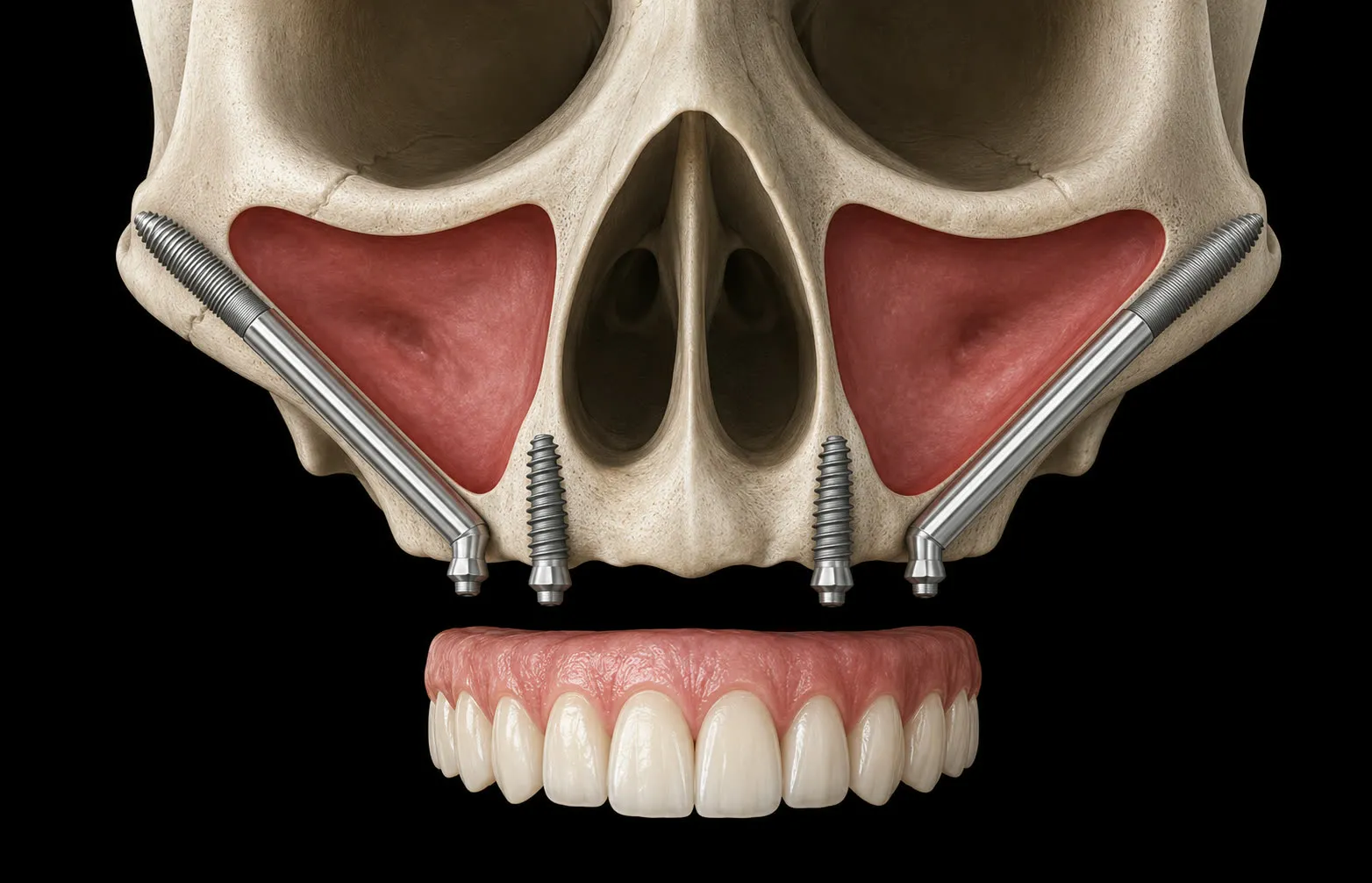
What can I do if I don't have enough bone for dental implants?
When there isn't enough bone for conventional implants, Dr. Fernando Giovanella, in Blumenau, Brazil, works through five options in a fixed order, from the smallest step to the largest: a bone graft (including a sinus lift); tilted implants that use the bone you still have in the front of the upper jaw; pterygoid implants that anchor behind it; zygomatic implants that anchor in the cheekbone; and, when even the front of the jaw is gone, four zygomatic implants. Which step is yours is not decided by what you were told, and not by what any clinic — mine included — would rather do. It's decided by a CBCT scan: a 3D image of your jaw that shows, in millimeters, how much bone is left and where. Everything below exists to help you read that scan with me.
- 1Bone graftincluding a sinus lift — adds bone, then waits for it to take
- 2Tilted implants (All-on-4)use the bone still in the front of the upper jaw
- 3Pterygoid implantsanchor behind the upper jaw
- 4Zygomatic implantsanchor in the cheekbone
- 5Four zygomatic implantswhen even the front of the jaw is gone
Why did I lose bone, and why does the cheekbone matter?
You lost bone because the bone was there for the teeth, and the teeth left — that is how Dr. Fernando Giovanella explains it to patients in Blumenau, Brazil, and it's the one idea that makes the rest of this page make sense. The part of the jaw that holds teeth is called the alveolar bone. Its job is to hold roots. Take the roots away and the body slowly reabsorbs it, as it does with any structure that has no work to do. A denture resting on the gum doesn't stop that; the pressure tends to speed it up. In the upper jaw there is a second thief: the maxillary sinus, the air space above your back teeth, which tends to grow downward into the room the roots left behind. So the back of the upper jaw thins from below and from above at the same time. This is not neglect. It's anatomy doing what it does once the teeth are gone, and it happens to careful people too.
With teeth
Years after the teeth go
- Alveolar bone — the part that held the roots. Take the roots away and the body reabsorbs it; a denture resting on it speeds that up.
- Maxillary sinus — the air space above the back teeth. It tends to grow downward into the room the roots left behind.
- Cheekbone (zygoma) — never held a tooth, so it doesn't shrink when teeth go. Dense, close, and right above the part that empties first.
The cheekbone — the zygoma — plays by different rules. It never held a tooth, so it doesn't shrink when teeth go. It's dense, it's close, and it sits right above the part of the upper jaw that empties out first. A zygomatic implant is simply a long implant that reaches past the missing bone and anchors there. Nothing has to be rebuilt first.
That's the logic of the whole ladder: each step uses bone you still have, a little further from where the teeth used to be. The first step stays closest of all — it tries to put the bone back.
When is a bone graft still the right choice?
A bone graft is still the right choice when the defect is small and the rest of the jaw is healthy — and at Dr. Fernando Giovanella's clinic in Blumenau, Brazil, that is not a reluctant answer. For one missing tooth, or a few, a graft that adds a few millimeters of width or height lets a conventional implant go exactly where the tooth was. That is good surgery, and when your CBCT shows it, I'll say so.
A graft means adding bone — your own, taken from another spot, or bone from a bank, or a synthetic substitute — and then waiting, usually several months, for it to become part of you before an implant can go in. A sinus lift belongs to this family: the surgeon lifts the membrane of the sinus and places bone under it, to regain height in the back of the upper jaw. Then the same wait.
Where grafting stops being the right choice is a matter of scale, and of history. When the whole upper jaw has thinned, a graft has to rebuild a lot, in several places, with healing that can take most of a year and sometimes a second surgery before the first implant. And when a graft has already failed once in that jaw, asking the same bone to hold a second one is a real decision, not an automatic next step. I'll come back to that further down.
Before you go that far, there is a step that uses the bone you already have.
Can All-on-4 work if I have little bone?
Often, yes — and when it can, it is the route Dr. Fernando Giovanella recommends first for a full upper arch in Blumenau, Brazil, before any zygomatic implant is mentioned. All-on-4 is a full set of fixed teeth carried by four implants. The two at the back are tilted, so they slip in front of the sinus and use the bone in the front of the upper jaw, between the sinuses, which is usually the last region to empty out. No graft, no months of waiting, and a bridge that can often be fixed to the implants soon after surgery.
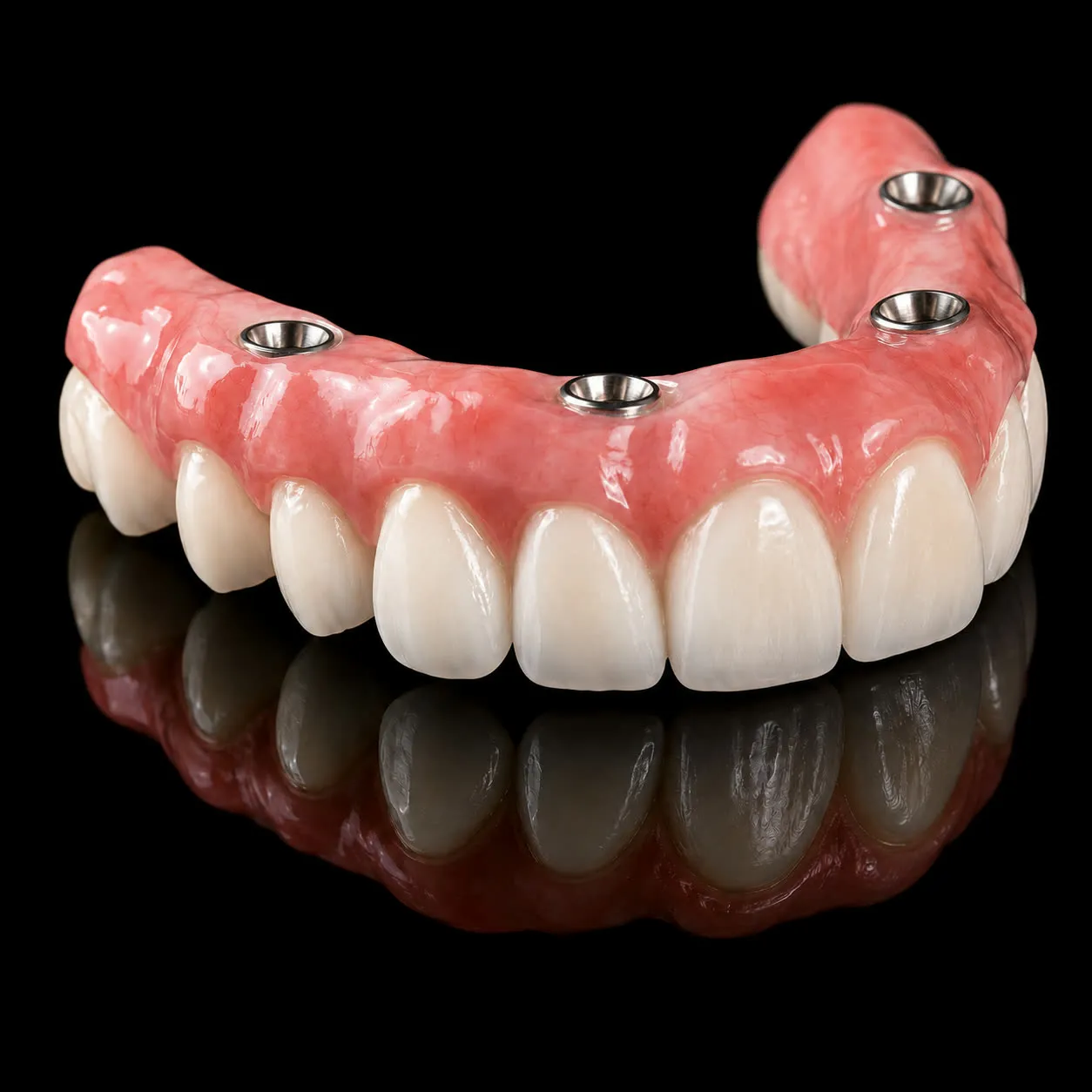
What it needs is that front bone. On the CBCT I'm looking for enough height and width between the canines to seat four implants with a good grip. When that bone is there — and it often is, even in people who were told "you have no bone" after a flat X-ray — tilted implants are the simpler, smaller operation, and the answer to "do I need zygomatic implants?" is no.
When that bone is not there, tilting doesn't help: there is nothing to tilt into. That's when the search moves to bone further away — behind the jaw first, then above it.
What are pterygoid implants, and when are they an option?
Pterygoid implants are long implants placed at the very back of the upper jaw, angled backward and upward into a dense column of bone behind it — and Dr. Fernando Giovanella uses them in Blumenau, Brazil, when the back of the jaw is empty but the front still has something to offer. That column is the pterygoid region, where the back of the maxilla meets the bones of the skull base. It's one of the few places up there that stays dense when the rest of the jaw thins, and it sits behind the sinus, not under it, so the sinus is left alone.
Who they suit: people whose CBCT shows usable bone in the front of the jaw and nothing usable at the back — the classic shape of a jaw that has worn a denture for years. The pterygoid implant carries the back of the bridge, so the bridge doesn't have to hang unsupported past the last implant, and no sinus lift is needed.
Who they don't: people with no front bone either. A pterygoid implant anchors the back of a bridge; it can't anchor a bridge alone. The region is also deep, and close to structures a surgeon has to respect, so it's a step for someone who places them regularly, planned on a CBCT and not improvised in the chair.
If the front of your jaw is gone too, the next anchor is above you.
Zygomatic implants or a bone graft — how do they compare?
Compared head to head, zygomatic implants and bone grafting trade one thing for another, and Dr. Fernando Giovanella would rather you hear the trade from him, in Blumenau, Brazil, than from a page that shows only one side. A zygomatic implant is a long implant — much longer than a conventional one — that enters at the ridge, runs alongside or through the wall of the maxillary sinus, and locks into the cheekbone. Because the cheekbone doesn't resorb, there is nothing to rebuild first and no months of waiting for a graft to take. Usually one goes on each side, with two to four conventional implants in the front, and the whole set carries one fixed bridge.
Here is what the studies say — the studies, not my results.
A Cochrane review published in 2026 compared zygomatic implants with bone grafting followed by conventional implants. At three years, zygomatic implants probably reduce implant failures and the time until you have fixed teeth — and probably increase the risk of complications. The evidence is of moderate certainty and rests on one randomized trial.4
That is the honest shape of it: fewer lost implants and faster teeth, more complications to manage. The sinus is where a surgeon pays the closest attention, because the implant travels beside it; what to watch for, and who handles it once you're home, has its own page — what the studies say about complications.
On how long they last, the reviews agree with each other. A 2016 systematic review of 68 studies — 4,556 zygomatic implants in 2,161 patients — reported a cumulative survival rate of 95.21% at 12 years.1 A 2023 meta-analysis reported 96.2% survival at six years, higher when the teeth were fixed to the implants immediately (98.1%) than when they were fixed later (95.0%).2 A review of studies that followed patients for at least five years put that survival alongside conventional implants — 96.5% against 95.8%, with no significant difference.3
Survival means the implant is still there and working. It isn't a promise about your case, and it isn't my number; it's what the literature reports across thousands of patients. What it tells you is this: the anchor holds. Whether you need it is a separate question — and there is one more step before we get there, for the jaw that has nothing left even in the front.
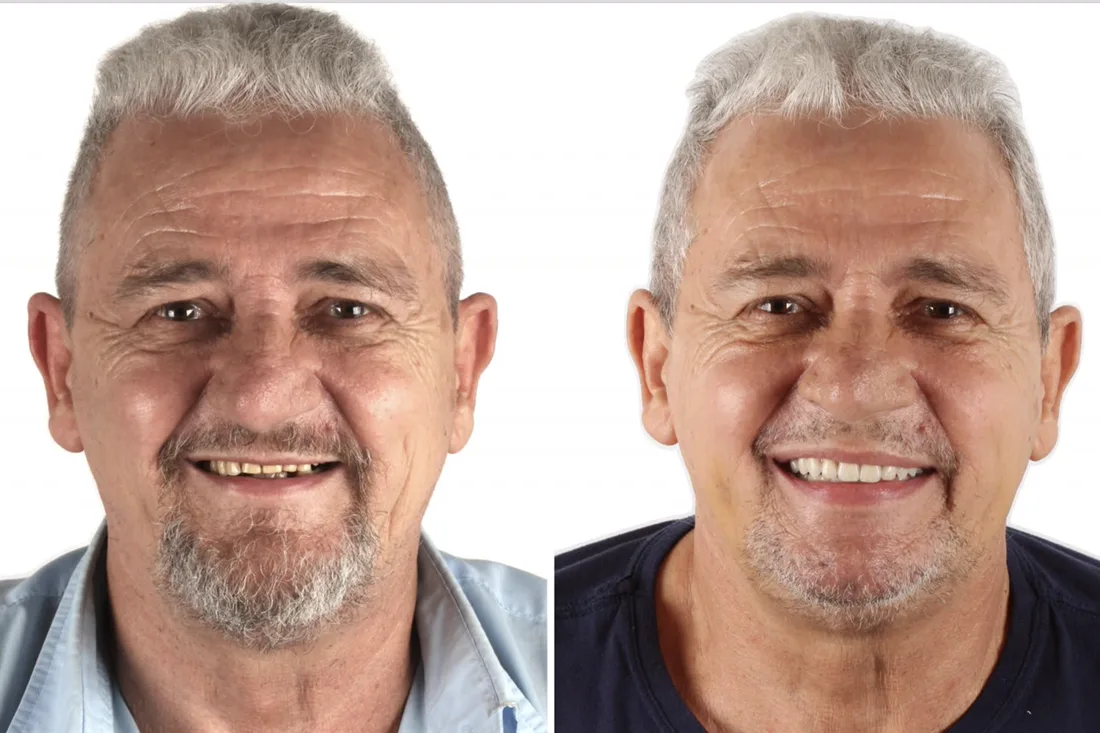
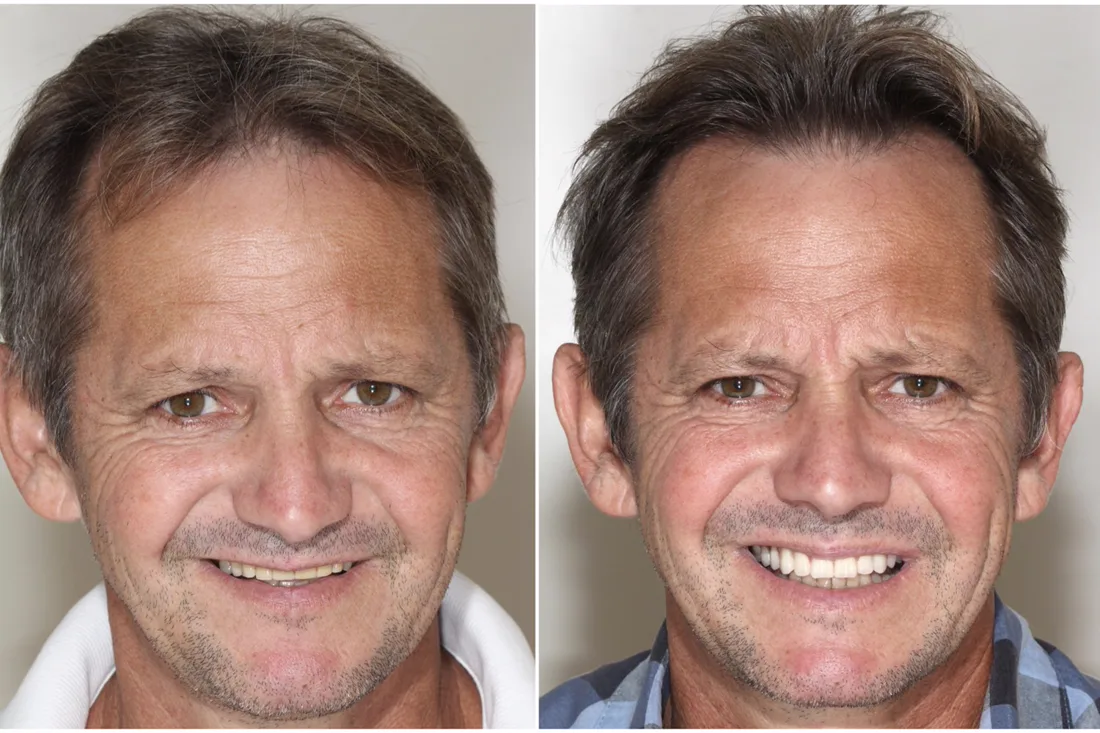
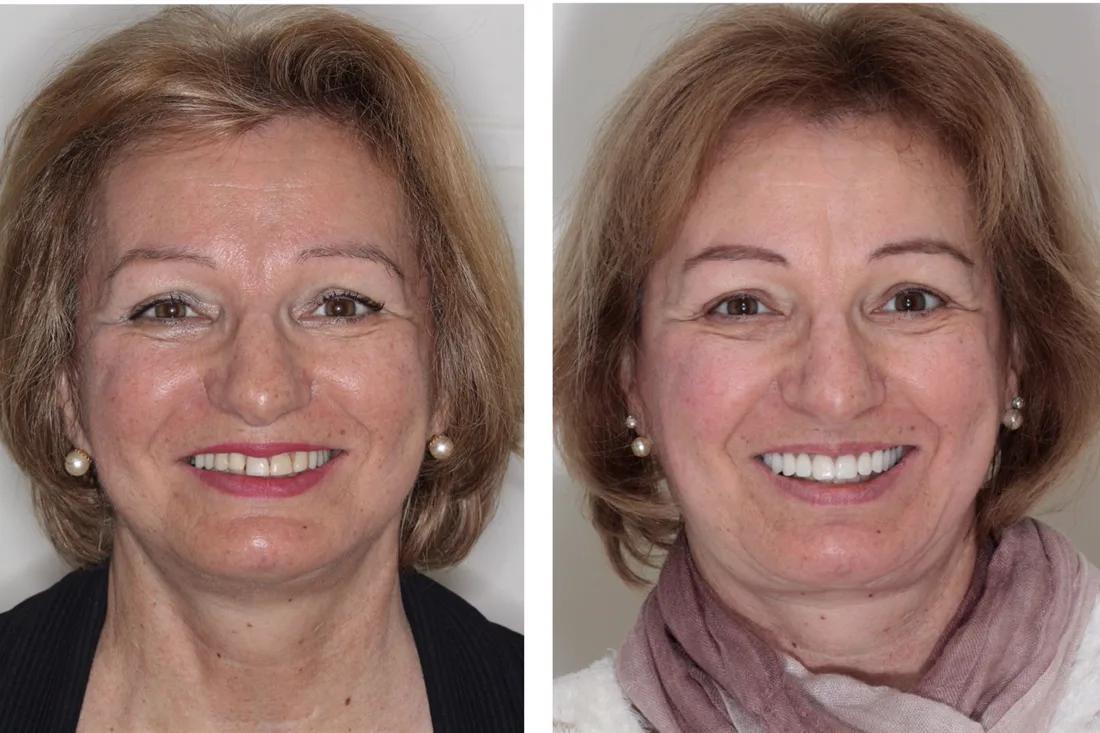
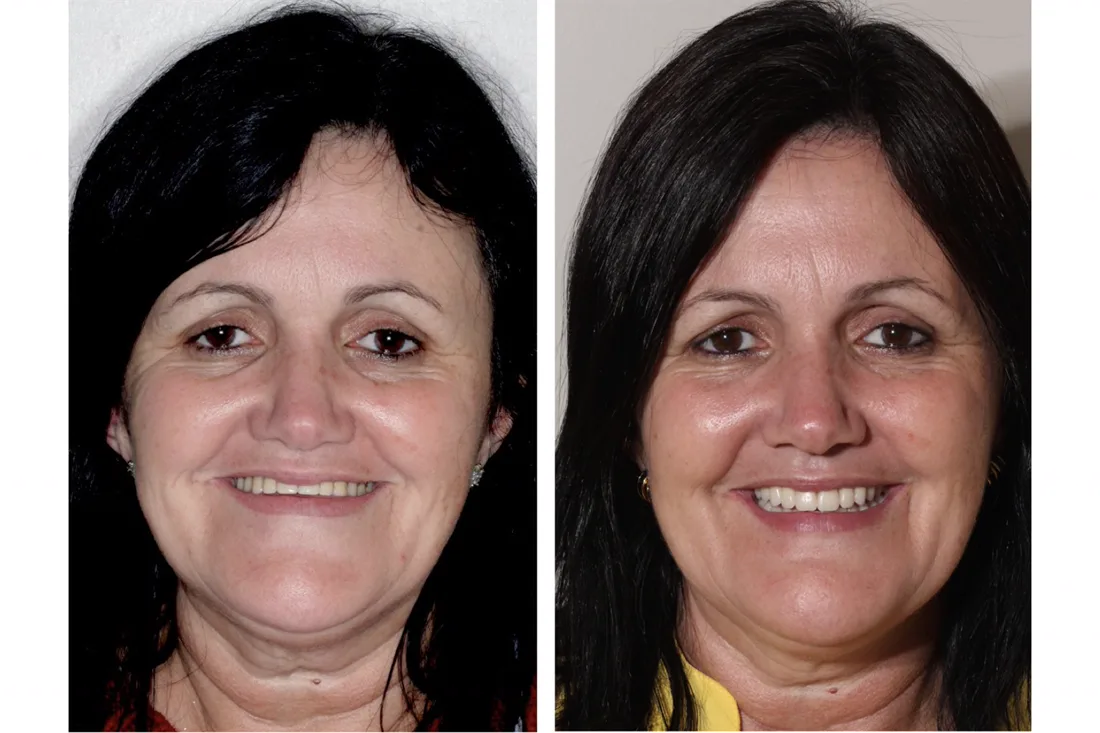
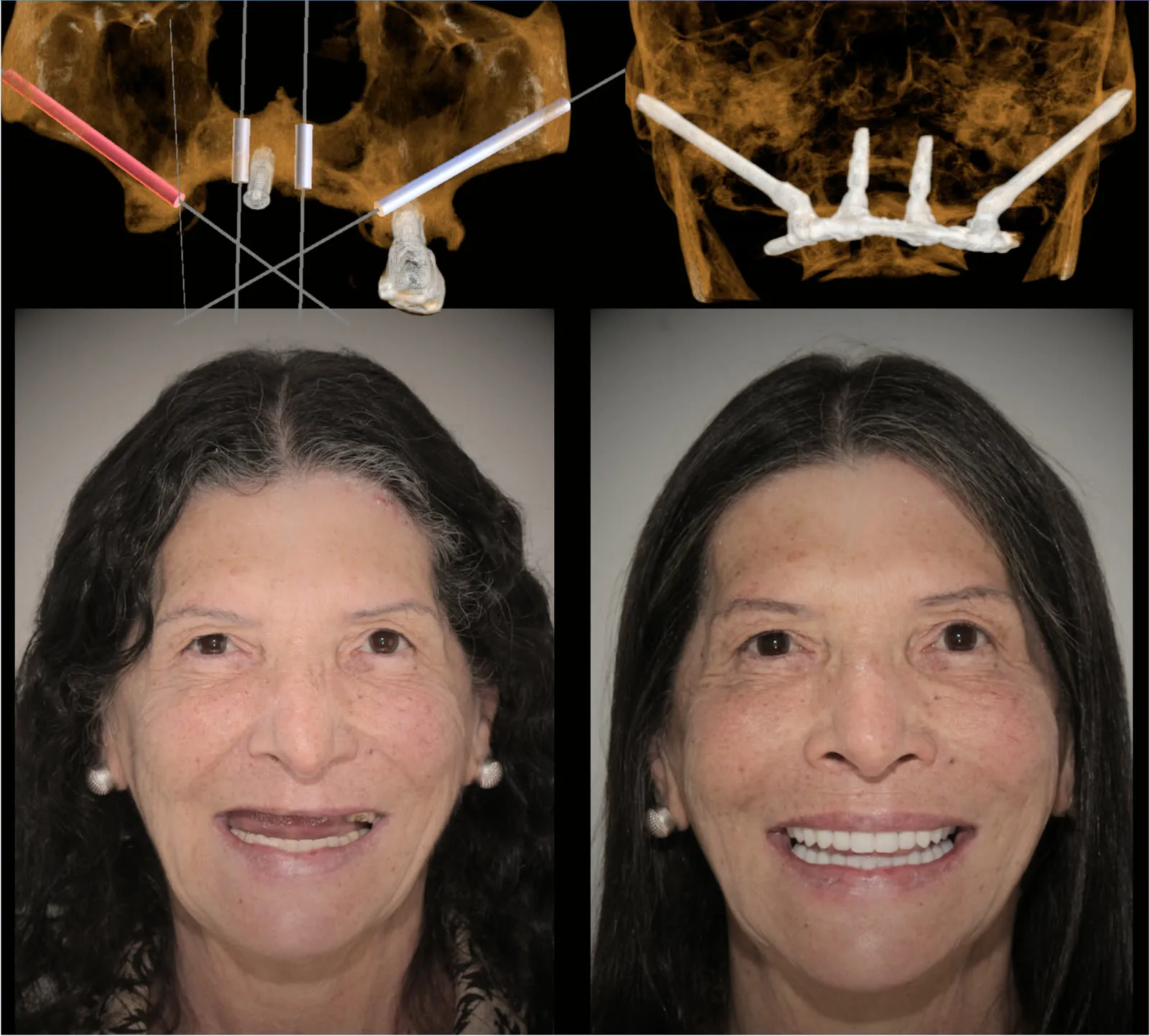
What if there isn't enough bone even for regular zygomatic implants?
Then the front implants come out of the plan and the cheekbone carries everything — two zygomatic implants on each side, four in all — which is the arrangement Dr. Fernando Giovanella reserves, in Blumenau, Brazil, for the upper jaw that has nothing usable left even between the canines. It's called a quad zygoma. It's for the rarest cases, it asks the most of the surgeon's planning, and it is still a decision made on a CBCT, not on how long you've been without teeth. what a quad zygoma involves
My bone graft failed. What are my options now?
If your graft failed, you still have the same ladder — Dr. Fernando Giovanella sees this often in Blumenau, Brazil — but you start reading it from a different place, because the jaw itself has told you something. A graft that resorbs, or gets infected, usually leaves the site with no more bone than before, sometimes less, and with scar tissue where the graft was. That doesn't close any door by itself. It does mean the next decision shouldn't be made on hope.
First, a new CBCT, once the site has settled. Not the scan from before the graft: that jaw no longer exists. Then the same reading as for anyone else. Is there front bone? Tilted implants may still be possible. Is there bone behind? Pterygoid. Is the ridge gone, but the cheekbone — which didn't resorb, because it never depended on teeth — right there above it? Then zygomatic implants are the step that doesn't depend on the bone that already let you down. Which is why, for this reader in particular, they come up so often.
What I won't do is tell you a second graft is wrong. Sometimes it's reasonable: a small, well-defined defect; a first failure with a clear cause that can be fixed. But I'd want to say out loud what it asks: the same months of waiting you've already paid once, a second surgery before the first implant, and no certainty that the second graft behaves better than the first. If you choose it with that said, that's a choice. If you choose it because nobody showed you the next rung, that's a gap in the conversation — and the point of this page is to close it.
How do I know whether I really need zygomatic implants?
Only a CBCT can tell you, and Dr. Fernando Giovanella, in Blumenau, Brazil, will not tell you anything else before he has seen yours. A panoramic X-ray shows the jaw flattened into one picture; a CBCT shows it in three dimensions, slice by slice, and lets me measure the bone where each implant would go. That measurement — not a photo of your smile, not a description over the phone — is the only thing that moves you from "probably" to "this step".
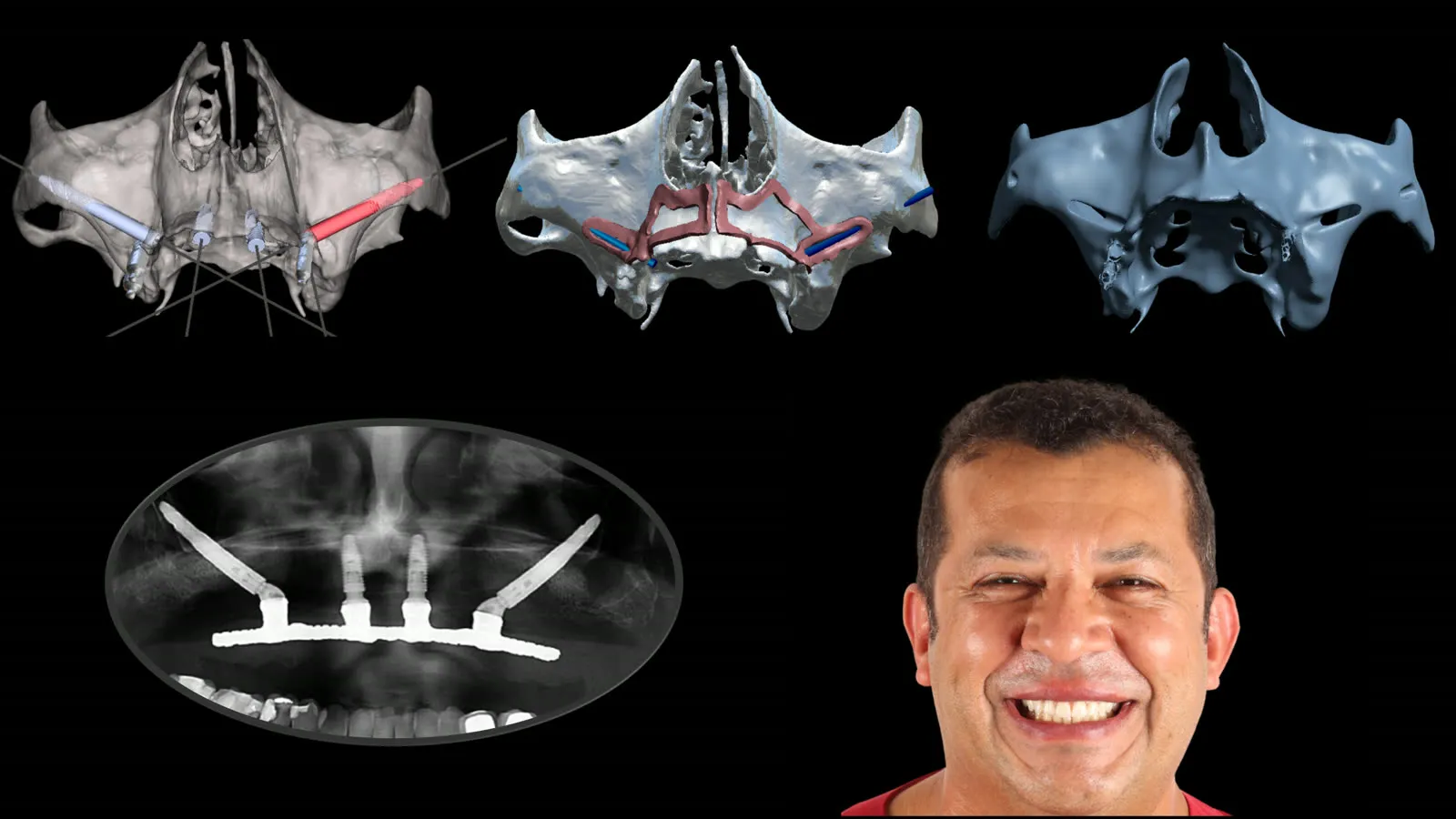
Here is how I read it. Front bone enough for four implants? You don't need zygomatic implants; tilted implants do the job. Front bone yes, back bone no? Tilted or pterygoid, no cheekbone involved. Ridge gone along most of the jaw? Now we're talking about zygomatic implants, and the scan tells me how many. I write that reading down and send it to you. If it says "you don't need me", it says so.
A second opinion is normal at this stage. Not disloyal to the dentist who treated you, not a sign that you're difficult — normal. Two surgeons reading the same CBCT may land on different rungs of this ladder, and you are allowed to hear both before you decide.
If you'd like my reading, send the scan, not a photo. how a remote review of your CBCT works
A written reading of your scan, from the surgeon who would operate — preliminary until I examine you in person. The message includes your consent to how the clinic handles health data — read it first. from your scan to your flight home — the sequence for patients who live abroad
Questions you may be asking yourself now
Should I just have my teeth removed and wear dentures instead?
You can, and for some people that's the right call: a denture is the smallest and most reversible option, and nobody should talk you out of one that serves you. Two caveats. The bone keeps shrinking under a denture, so the one that fits today fits worse in a few years. And an upper denture covers the palate, which is why taste often suffers. If yours still holds, keep it. If it doesn't, this ladder is for you.
Can I get dental implants without a bone graft?
Often, yes. Three kinds of implant are designed to use bone you already have instead of bone added by a graft: tilted implants in the front of the upper jaw (All-on-4), pterygoid implants behind it, and zygomatic implants in the cheekbone. Short implants are a fourth option where there's height enough for them. Which one, or whether a small defect is still better served by a graft, is read from your CBCT — not from a "no" you once heard.
How do I know if my bone graft has failed?
Not by yourself, usually; the surgeon who placed it confirms it with an exam and a CBCT a few months on. What patients notice first: grains of graft material working out through the gum, swelling or pain that settles and then returns, discharge, or a site that never firms up. What the scan shows: the volume that was added is no longer there. If any of that sounds familiar, go back to whoever grafted you; that visit closes no doors.
Can zygomatic implants be used in the lower jaw?
No. Zygomatic implants anchor in the cheekbone, which sits above the upper jaw; there is no equivalent bone to reach from the lower jaw. And the lower jaw rarely needs them: it keeps its bone in the front longer, it's denser, and a full set of fixed lower teeth is usually carried by conventional implants placed there. When both jaws need treating, the plan is usually zygomatic implants above and conventional implants below, planned together.
Can zygomatic implants hold a full set of fixed teeth?
Yes — it's their usual job. A zygomatic implant isn't used for a single tooth; it anchors a full fixed bridge for the upper jaw, usually with conventional implants in front, or as four zygomatic implants when the front has no bone. The literature reports that fixing the teeth immediately after surgery goes with higher survival, not lower (98.1% against 95.0% in a 2023 meta-analysis).2 Whether your case allows that is decided in planning, not promised on a page.
Can implants bring back the shape of my face?
Partly, and I'd rather be exact about which part. What fixed teeth on implants restore is support: the lip and the cheek have something to rest on again, and the "sunken" look that comes with a loose denture or no teeth usually softens. What they don't do is regrow the bone itself; the jaw stays the size it is. So expect a face that looks like yours again, not a younger one. Anyone promising more than that is selling something.
Can I get "permanent dentures" if I have bone loss?
Yes, if by "permanent dentures" you mean teeth that are fixed to implants and don't come out — that's a bridge screwed onto implants, and every step on this page leads to one. Two words of honesty about "permanent". Fixed, yes: you don't take it out at night. Maintenance-free, no: like anything in the mouth it needs cleaning, check-ups and, over the years, repairs or a replacement of the bridge. Designed to last — not designed to be forgotten.
What about basal or subperiosteal implants?
They exist, and some surgeons use them. Basal implants anchor in the dense base of the jaw; a subperiosteal implant is a custom frame that sits on top of the bone, under the gum, an old idea revived with 3D printing. This page doesn't cover them, and I won't give you numbers I haven't checked against the sources below. Whatever option you weigh, ask the same question this page asks of zygomatic implants: what do the long-term follow-up studies report?
Is a sinus lift the same as a bone graft?
A sinus lift is one kind of bone graft, not something else. "Bone graft" is the family: adding bone where it's missing and waiting months for it to take. A sinus lift is the member used in the back of the upper jaw: the surgeon lifts the sinus membrane and packs bone beneath it to regain height for an implant. Tilted, pterygoid and zygomatic implants are the options that go around the sinus instead of filling under it.
References
- Chrcanovic BR, Albrektsson T, Wennerberg A. Survival and complications of zygomatic implants: an updated systematic review. J Oral Maxillofac Surg. 2016;74(10):1949–64. doi:10.1016/j.joms.2016.06.166 · PMID 27422530. https://pubmed.ncbi.nlm.nih.gov/27422530/ — accessed 6 October 2026.
- Brennand Roper M, et al. Long-term treatment outcomes with zygomatic implants: a systematic review and meta-analysis. Int J Implant Dent. 2023;9(1):21. doi:10.1186/s40729-023-00479-x · PMID 37405545. https://doi.org/10.1186/s40729-023-00479-x — accessed 6 October 2026.
- Moraschini V, et al. Survival and complications of zygomatic implants compared to conventional implants reported in longitudinal studies with a follow-up period of at least 5 years: a systematic review and meta-analysis. Clin Implant Dent Relat Res. 2023;25(1):177–189. doi:10.1111/cid.13153 · PMID 36373779. https://doi.org/10.1111/cid.13153 — accessed 6 October 2026.
- Visconti RF, Greco K, Cotticelli C, Ambrosi A, Esposito MA. Interventions for replacing missing teeth: zygomatic implants for the rehabilitation of the severely atrophic edentulous maxilla. Cochrane Database Syst Rev. 2026;7(7):CD004151. doi:10.1002/14651858.CD004151.pub4 · PMID 42489150. https://www.cochranelibrary.com/cdsr/doi/10.1002/14651858.CD004151.pub4/full — accessed 6 October 2026.
- Santa Catarina Regional Dental Council (CRO-SC) — public registry search. https://cro-sc.implanta.net.br/servicosonline/Publico/ConsultaInscritos/ — accessed 6 October 2026.
- Federal Council of Dentistry (CFO), Brazil — public registry search. https://website.cfo.org.br/consulta-inscritos/ — accessed 6 October 2026.
About this guide
Reviewed and approved by Dr. Fernando Giovanella, CRO-SC 8237 · Updated October 2026 · Next review: April 2027
Where the facts come from. Every number on this page comes from a primary source listed under References, with the date it was checked. Explanations without a number describe how these procedures work in general; they were reviewed by Dr. Giovanella and are not a promise about any one case. What this guide does not publish: prices, patient names, before-and-after images without consent, star ratings, or comparisons with other surgeons or countries.
How to check the registration. The public registries of the Santa Catarina Regional Dental Council and the Federal Council of Dentistry list every registered dentist in Brazil. Search "Fernando Giovanella", Santa Catarina.5,6
Conflicts of interest. Dr. Giovanella is a paid research-and-development consultant to an implant manufacturer and is the designer of surgical instruments with patent applications pending in Brazil. The full declaration is on the editorial policy page.
Found a mistake? Send it to the clinic on WhatsApp (the same button above) or by e-mail at atendimento@fernandogiovanella.com. You'll have an answer within five business days; corrections are made and dated on the page.